Tuesday, July 17, 2012

Gibraltar

We arrived in Algeciras, a city on the Atlantic/Mediterranean coast of Spain, after another five hour train ride from Madrid. The journey over the southern portion of Spain exposed us to a very dry, rocky and hilly landscape – a landscape that was covered in olive trees, sunflower fields and sparsely scattered signs of human settlement over the years. As we got further south, the towns took on a typical Mediterranean feel with their whitewash walls and box like appearance.


As it was Sunday evening when we arrived in Algeciras, pretty much everything was closed. Adam had been in charge of booking our hotel for the evening, but we struggled to find its location in the web of the city. Once we did arrive, our hostel (Lisboa Hostel) was deemed a ‘fail’ by my travel companion because of its squeaky bed, poor facilities and unusable internet connection, for which we were paying almost as much as in Madrid. It goes to show that taking the time to read the reviews from multiple sites about your prospective accommodation often allows you to get better value for your dollar. (I recommend using a travel guide, hostelbookers.com and tripadvisor.com together to make your decision.)

Monday we were going to Morocco, however we did not yet have a plan as to when we would depart, where we were going to go and how we were going to get there. Our three options included 1) taking a ferry to Ceuta, which is one of a handful of Spanish possessions on the coast of Morocco, then crossing into Morocco and taking a bus to Chefchaouen, 2) taking a ferry to Tangier and then taking a bus to Chefchaouen, or 3) visiting Gibraltar, which is a British possession on the coast of Spain, then going to Tangier and skipping Chefchaouen. At times, when there are so many options of interesting places to visit and famous sights to be seen, it is discouraging that there is not more time in the day or days in the week to visit them all. We decided to go to Gibraltar because of its historical importance, its unique political and cultural reality, and the beautiful vistas we could see from the rock.

Arriving in Gibraltar, I hadn’t known that the city was in fact a British possession and that we would need to cross the border to enter. Once we got in, it was eerie how the language immediately changed from Spanish to English, that the Euro was replaced by the Pound, and that signs of Britain’s imperialism became so forthright.
Immediately guided taxi tours were on our case to sell us their sightseeing packages. However, Adam and I chose to take the gondola to the top of the rock and then walk through the nature reserve, the area where the historical buildings, can be visited. We were surprised how few people were visiting the rock when we arrived, until we realized that most tourists were coming later in the day and that most did indeed take the taxi tours. Since Adam and I both like to walk and adventure ‘off the beaten path’, for others who also prefer being more active in their touring, I would strongly encourage you to walk the Gibraltar rock. There are many staircases and paths that are only available on foot which the taxi tours will not access, there are so many taxis that there are often traffic jams on the single lane road, and you are able to spend more or less time in the places you enjoy when you are on your own schedule.


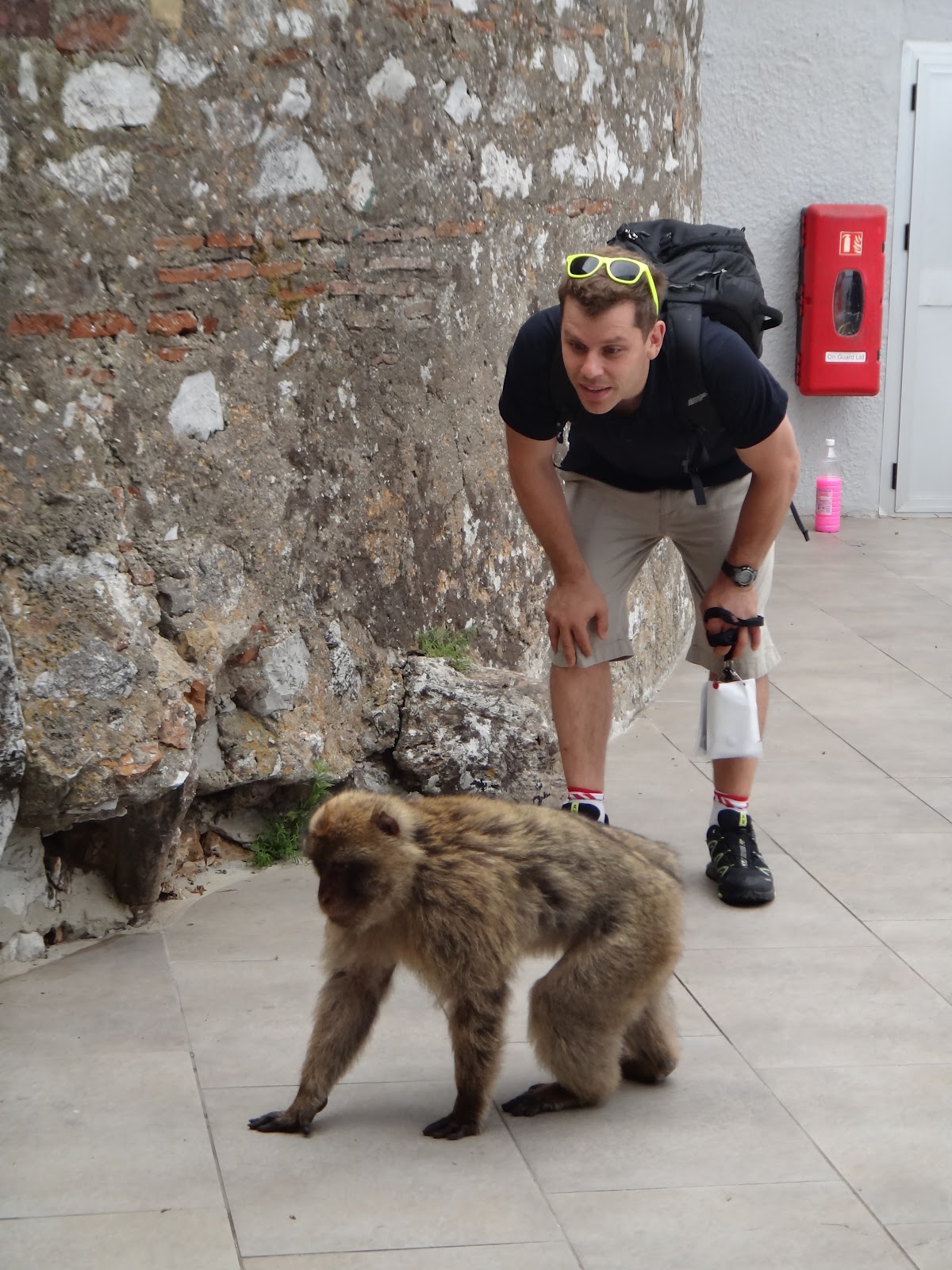
One of the main attractions in Gibraltar, especially on the rock, are the monkeys. Apparently they are part of a relatively rare breed and have a significant part in the history of Gibraltar. Part of their allure is that it is unknown how the monkeys arrived in Gibraltar. The rest of the allure is that monkeys are very entertaining creatures. The ones in the nature reserve are fed and vaccinated. There are warning everywhere though that the monkeys will grab and bite you. In real life, they are in fact quite frightening. The monkeys were Adam’s favourite part of our visit – that is until one tried to grab his camera from his pocket and when he grabbed it back the money jumped at his face. The monkey’s aggression was enough to scare Adam forcing him fall down and get a headache from the whole experience. Unfortunately I was not there to witness the events, but Adam was definitely shaken from the whole experience.

We covered a significant distance walking back and forth down the rock. On the route we visited the old Moorish castle, caves, the monkey den, the siege tunnels and even climbed an old path up to the World War II bunker near the top of the rock. The bunker hike was my favourite part because it was a less travelled path, the history was much more modern, and the location of the bunker allowed for amazing vistas of all sides of the peninsula. Either way, it was very apparent that Gibraltar, from top to bottom, consists of layer upon layer of history, primarily military based. The Spaniards, the African Moors, the British and even the Dutch have had significant stake in this piece of land that acts as the gate to the Mediterranean.

Madrid

We arrived in Madrid on a Friday afternoon. The train from Pamplona was a five hour ride. In Madrid, we were staying at our first airbnb.com apartment on our trip, and neither Adam nor I had ever used the service on our own before. (Airbnb.com is an international accommodation website where people rent out their apartments or rooms in their apartments to guests. Essentially, you can get luxury hotel quality for a fraction of the price by staying in someone’s home.) Our host had given us directions to the subway station near his home, but while we were en route I realized that I didn’t actually have an address for his apartment, just the street name. Embarrassed to be missing such a key piece of information for our arrival destination, I told Adam that I didn’t have the address exactly, but I’m sure we could figure it out. As soon as we got to the exit doors of the metro station and were about to begin our search, a man started waiving at us. Our host had come to the station to wait for us since I had given him our arrival time and knew it would be easier to walk us to the apartment and give us the information in person rather than try and do it all by email. We were both shocked and relieved that he had been so giving of his time to meet us.

The first evening in Madrid we walked to the cathedral, the crypt, the royal palace, through historic Madrid (which is not a shopping district) and down past some of the architectural icons of the city. From the time we arrived Adam couldn’t believe how fashionable the people of Madrid were and became increasingly more self-conscious of his gortex salomon sneakers which are clearly a Vancouver purchase.


The royal cathedral and the royal palace are unbelievable examples of the grandeur of emperial Spain. Both Adam and I were awestruck by the juxtaposition of the heaviness of the building materials and the loftiness of the height of the cathedral. The crypt was very traditional with a much older aesthetic for it's stained glass and mosaics, whereas the cathedral above was surprisingly modern with many abstractions and optical illusions in its space.

The royal palace is in a class of its own. Used up until recently (the last 100 or so years), the Spanish government has done an excellent job of restoring and maintaining the interior and exterior of the buildling. Most of the rooms were restored to the time of Kind Carlos III which is considered the golden age of Spain's rule.

Travelling with a partner allows you to do activities you would never do on your own and challenges you to enjoy parts of a culture you wouldn't otherwise think to enjoy. For example, when we walked into Plaza del Sol I was immediately drawn to the open space and the overwhelming activity and commerce taking place in the street, whereas Adam was drawn to an arcade underneath a scaffolded building. We went in and before I knew it I was putting 20 Euro cent into the slot machine trying to win my prize. Luckily we didn't stay for long, but I will admit we were both having a good time.

Reading a travelbook about Madrid, I learned that the city is the home of Picasso's famous painting Guernica. We had to go to the Reine Sofia Museum to see the famous piece of art. So early on our second day we headed to the museum and ended up spending over three hours enjoying the works of Picasso, Miro, Dali and many other Spanish greats. Picasso's studies in preparation for producing Guernica were likely my favourite. There are a series of abstracted wailing mothers who have lost their children that evoke so much emotion within the piece themselves and within the viewer. Adam's favourite part were the intricate details of Dali's paintings. Being able to get up close and personal with the originals pieces allowed us to appreciate the technique and the minutia of what was really capture or expressed in each piece.


I thoroughly enjoy going to the theatre in foreign countries, especially in Europe. We bought tickets to see a modern opera called Ainadamar at the Teatro Real - the royal theatre. Prior to the show, I expressed that I typically don't like operas that have primarily female vocalists, however Ainadamar has changed my perspective. It was the first opera that I have seen in Spanish, and what a difference language makes! The singing was so melodious (especially compared to the German operas I have seen in recent years) and the orchestra, which is alwasy a highlight for me for any show. l was impressed that the opera had so many Spanish influences including two guitars which I had never seen before. It increased the breath of musical combinations available to the performance. Plus, the show was subtitled in both English and Spanish. I had to stop reading the English translations because they were so poor and were ruining the sophisticated sound of the opera for me, however the fact that they were provided was impressive.
Travelling on a budget, it has been a challenge for Adam to see the many discounts that I get at each of our destinations. Europe is extremely accomodating to students and people under the age of 30 in a financial sense. For example, at the royal palace my entry fee was half Adam's because I was a student. At the Reine Sofia Museum my entry was free whereas Adam had to pay. At the theatre, buying the tickets the same day as the show, I received 90% off any price point in the theatre, whereas Adam had to pay full. I've tried to convince him that we are fortunate that we are saving so much money because of my student status and age, however it is a bit of a blow to him to have to pay full price when he sees me getting such amazing deals.
Sunday morning we had talked about going to the cathedral to enjoy the service and the music of the organ, but then we found out that there was a huge antiques and other market with up to 3600 vendors in the old downtown core, so we changed our plans. (I have always enjoyed markets, and Adam can be described as a deal-finder enthusiast.) One of the perks of staying with airbnb.com accomodation, is that they often offer unique advantages to their guests, and at our place, our host had two bikes available for us to use. We biked up to the market and had a blast. The most impressive streets were those filled with antiques and art. I know a part of Adam was dissapointed that we were unable to make purchases for our apartment and get them home easily. We plan to look into putting a Moroccon care package for ourselves together to send back to Canada in the next wee to make up for what we left behind in Spain.

Monday, July 16, 2012

Pamplona

Leaving Canada behind once again, Adam and I found ourselves in a whirlwind of movement and international travel to get to achieve our first trip goal: Get to Pamplona, Spain to run with the bulls during their San Fermin festival.

We started by flying from Vancouver to London after one day of rest in Vancouver after our hike. In London, we immediately took the underground to get to our accommodation for the first night, Adam’s mother’s house. We will be spending a significant amount of time there at the end of our trip when we plan to explore the London Olympics. 
The next day, we had some time to do some shopping before making our way to continental Europe, so Adam’s mother had suggested that we all go to an antiques auction she knows about. I have never been to an auction, as far as I can recollect, so the prospect of being a part of a bidding war was very enticing. We headed to the auction house early enough to check out the lots which included furniture, art, jewellery, dishware and an assortment of historical items. We paid for a paddle just in case something came up that was irresistible. Well, what was most irresistible to our group was a cheap deal, and Adam and I walked away with two new art pieces for our apartment – pieces that for some reason no one else was willing to bid on, so we won them for bottom dollar. The prize possession of the two is ‘The Colonel’, a piece about which the auction house employee said to Adam, “What prompted you to buy this?” as he handed it over at the end of the event. Tongue-in- cheek apparently, though I think it’s pretty awesome, plus we got to bid at an auction!


Leaving London very quickly behind, we too the Eurostar to Paris for the night. There we met up with my friend Paul with whom I had farmed at Klipper’s Organics in Cawston, BC the previous year. He lives in Paris with his family and goes to the Sorbonne where he studies law. Unfortunately, our meet up was delayed because we had to activate our Eurail pass and make reservations for our train the subsequent morning. For those of you who have never travelled with Eurail, I caution you that this form of travel is not as ‘free’ as is often believed. After an hour in line at Gard du Nord in Paris, we were disappointed to learn that the Eurail seats on the trip we wanted to take were sold out. Our only options were to take five different trains and increase our travel time from 9 hours to 11 hours or to pay for full priced tickets. We opted to buy the tickets at around 110 Euro each.


Given it was our first time travelling together, Adam and I agreed that if we had to eat costs it was something we were willing to do to reduce the stress on ourselves during the trip. Having to pay extra for the train tickets was definitely our first test, but we were able to sort it out together.
Paul came to pick us up at the Gard du Nord. From there we went to have a typical French cafĂ©-style dinner on one of the streets of Paris, then we headed to meet some of his friends to drink wine beside the Seine. The evening and the ambiance were fabulous. One of the highlights was one of Paul’s friends who is a French rapper rapping over every beat or sound that was made available.

Early the next morning we were off to Pamplona. Neither Adam or I had ever been to Spain before, so we were both eager to see the landscape, meet the people and experience the culture. The challenge on the way to Pamplona was for the first three hours of the train ride, Adam had to stand in the train because we had bought ‘floating’ tickets, and weren’t in fact assigned to any seats. Luckily, after Bordeaux we were able to both sit together for the remainder of the journey.

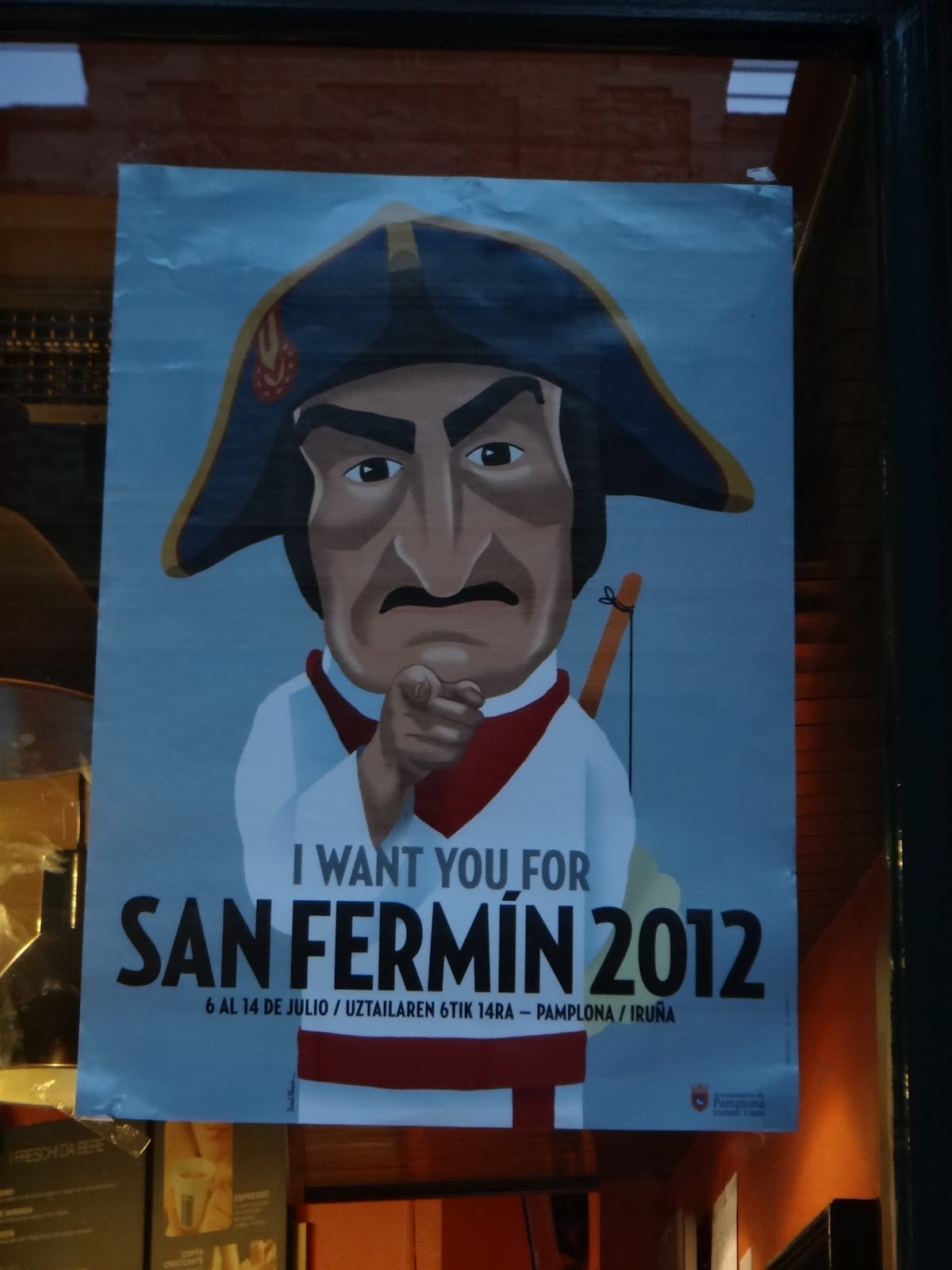
Pulling into Pamplona, it was very evident that we had arrived at a party. Everyone was wearing red and white, the traditional colours for the San Fermin festival, and the crowd looked like they had just come from a good time. Immediately we went to reserve all the train tickets we required for Spain so as not to end up in a similar situation as we had in France. There was no line-up and all our trains were available! Also, it was the first time Adam has heard me speak and interact in Spanish, and he quickly shared with me that he was very impressed that I can communicate so effectively in a language I refer to as my weakest language. After a night of speaking in French in Paris, Adam also said that he is quite certain my Spanish is stronger than his French.
I guess my languages are one of the reasons I feel so confident travelling on my own. I do prefer to travel to countries where I will be able to converse and exist without too many issues, and thus far, the fact that I have been able to speak the languages I do has been very beneficial to us as we are able to get to places and get the items we want very quickly without having to struggle to express our desires to strangers in a foreign tongue.

We arrived at our hotel, the most expensive one in which we are staying on our trip ($70/night each) primarily because of the festival. The hotel was nice, but unfortunately the room to which we had been assigned was a smoking room. Not being able to bear the overwhelming odour, we were able to have our room changed (and even upgraded) to a non-smoking room with a view of the city and a Jacuzzi tub (which ended up being very well used after our long days walking around Pamplona). We were so easily accommodated because I often have respiratory problems and the air could easily aggravate our health.


In the evening we went to town to find some dinner, though we were quite tire after staying up most of the night in Paris and then travelling all day. We were staying about a 30 minute bus ride out of town, yet the transit was very convenient and I would not consider the distance a deterrent from staying at Hotel Andia again in the future. The fairgrounds took over a significant portion of the city. We decided to eat at an outdoor cafeteria where food vendors were selling unusual combinations of what must be tradition Spanish cuisine. I ate steamed octopus with potatoes covered in olive oil and paprika. Delicious! There were also paellas, barbequed meats of all kinds, cold mushrooms with onions and lots of chorizo too. We then walked through the market area before finding the dessert section of the festival where Adam quickly bought us a bag of churros, which are deep fried batter sticks covered in sugar. If we weren’t walking as much as we are, I am convinced we would be returning to Canada a little more plump than we will be.

Our one full day in Pamplona was game day. We woke up at 5:25 am to take the 5:50 am bus with the other ambitious Hotel Andia guests to get to the running road before 6:30 am so that Adam could be well positioned for the run before the police clear the street at 7.00 am. When we arrived to the downtown core, it would not have been obvious that it was just after 6.00 am, because the streets were littered with people celebrating (read stumbling around in a drunken stupor), cheering and preparing for daylight to arrive. Apparently during San Fermin it is a common practice to go out all night until the bull run happens at 8.00 am and then go home. However, the danger is that many of the individuals who end up being gored in the run are those that go out drinking the night before and at some point in the night decide it would be a fabulous idea to do the run, and then are not in a physical or mental state to stay alert when the bulls are released. It is these people that the police heavily monitor during the run. All of the people Adam met lining up for the run were sober and there to safely experience the world-renowned cultural experience.
I was not running. I made my way to the end of the running route to be sure to get one of the limited spots on the fence to watch the race. Every day the city puts up and tears down this massive wooden fences along the running track. If you are not there right when the fence goes up (usually around 6.30 – 7.00), you will not be getting a seat. So I sat there on the fence and made friends with two Ecuadorians and a Mexican as I waited for Adam to run by. I had zero confidence that I would be able to spot him in a crowd of men all wearing red and white, but you never know right?


In fact, I didn’t see Adam during the run, but I took a video of the first minute of the event and it turns out that I captured Adam in my video! He was one of the lucky few that was far enough ahead of the pack that he made it into the bull ring at the end of the run where he was able to ‘play’ with smaller more docile bulls for an additional 30 minutes in front of a stadium full of people. Unfortunately I had to hear about the second part of his morning second hand because we had had a miscommunication, and I thought we were going to meet right after the run at our meet up spot. When Adam hadn’t shown up 30 minutes after the run was clearly over, I was convinced he was in the hospital, even though I also was convinced Adam was one of those people that never really gets hurt. I didn’t know what was going on! In my mind I had told myself that the run had been too ‘tame’ for Adam and so he had decided to spice it up by slapping the bulls and weaving in front of them at which point he got gored or knocked over….luckily none of these things happened, though he told me I was right about the him being bored by the run.

The morning we enjoyed fresh bread, cheese, cured meat and a coffee sitting together on a side street in the sun coming down from the high of the morning. We then walked around the city to explore the churches and historical parts of the town. There was so much activity, it is impossible not to be entertained during San Fermin. The gorgeous sunny weather didn’t hurt as well.

We definitely took advantage of the Spanish siesta for the afternoon after a busy morning. The evening we were starting with going to our first bull fight. Now prior to coming to Pamplona, I was unaware that the bulls are actually killed during a bull fight. Apparently I had imagined a Sesame Street version of bullfighting up until this point in my life where the bullfighter gets points based on how well he can control the movements of the bull using his red flag. The goal in my imagined bullfighting, was for a bullfighter to get the most points and then win the tournament. So, the real concept of bullfighting was something very new to me when we arrived in Spain.

We got tickets easily and walked into a rowdy stadium. When you buy tickets you buy either in the sun or in the shade. There are two groups of people that come to watch a bullfight – 1) those who are interested in the art or sport of bullfighting and 2) those who want to get rowdy and drink. The first group sits in the shade and the second sits in the sun. We were sitting on the cusp on the sunny side.

Unusual traditions in the crowds during a bullfight were that if it is someone’s birthday (or if someone is accused of having a birthday that day) the crowd covers them in red wine. Other traditions included eating dinner after the first round of fights – each bullfighter gets to fight two bulls.

The bullfight. The bull is released and chases three novice bullfighters around the ring to get tired. Once he is tired, two horsemen come out , who sit atop horses that are covered in a protective blanket, and the bull is stabbed in the back by the horsemen. The bull, not being pleased with the back stabbing, usually attacks the horse trying to gore the horse with its horns, however I was most impressed that the horses stood still and took the beating through their protective layers. The bull is then stabbed with six batons that stay attached to the bull for the remainder of the fight. Adam and I were both disappointed that the bull was bled (literally) of its energy before the real bullfighter came out to taunt it. Having worked with cattle for an extended period this year, I do recognize that anything can happen when working with animals, but the odds of the bull having a chance to challenge the bullfighter are greatly reduced. The bullfighter then leads the bull in a series of moves to exhaust it even further before taking a sword and stabbing it through the back. The bull then collapses to the ground and is dragged off by horses.

Adam was routing for the bulls to win. Sadly, the one time the bull got the better of the bullfighter and rolled him around the ring for a distance Adam was in the bathroom! Adam had left to go find the washroom and soon thereafter the people sitting around me started to tell me that I was never going to see him again. Apparently the bathrooms are difficult to locate in the arena. He had been gone such a long time, I was starting to believe they might be right, but kept trying to assure them that Adam is quite capable when it comes to challenging situations. So when he did return and we all cheered for him it was quite a relief.
The night we drank and celebrated with the rest of Pamplona including enjoying the nightly fireworks before saying goodbye to our first Spanish destination. One we both considered a success.

Friday, July 13, 2012

North Coast Trail: Nels Bight to San Josef


The hike out from Nels Bight was the longest route we had to cover in all our hiking days, but also the easiest. With our packs free of all food weight, our legs just a little stronger, our minds able to better read the forest floor on which we walked, we were able to cover significant ground in a short time. For most of the trip, I refered to myself as the tortoise and the others as the hares, since I was often the one who lagged behind at a somewhat slower pace than the pack, but on the last day, with my long legs and the easy ground, it was joked that the hare in me had kicked into gear. It was fun to push forward at a quicker pace.

The scenery was beautiful. We crossed through a gorgeous field, learned some of the agricultural and settlement history of the land, and even saw the artifacts that remain from some of the original inhabitants.

It took us just under six hours to do the trail before arriving at the parking lot where fresh clothes and a bottle of wine I had packed awaited our arrival. It was very rewarding to drop our bags in the trunks of the cars and pass around the bottle of wine.

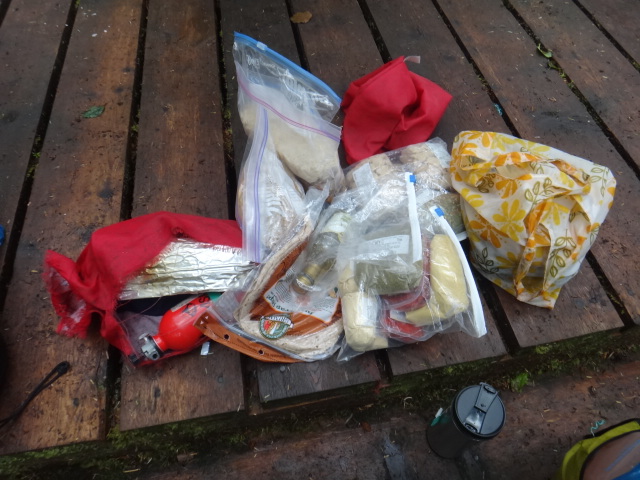
One last piece of advice for future hikers - make the effort and take the time to plan your meals. We were extremely spoiled that Christine took such an interest in one of her new cook books that has recipes for dehydrated meals. We ate three meals and at least three snacks a day every day which included a lot of protein, carbs and vegetables too! Your body will need the energy and it will allow you to be at your best every step of the way. That being said, a good portion of our weight that could have been off loaded was our food. I would have said before we left that we packed too much food, yet none of it remained at the end of the trip (other than our emergency food). So, unless you are willing to go to bed hungry, carry the extra weight. (Below is the food carried by Adam and I for the group for the trip.)


As we drove out the San Josef road, we had to make one last stop to conclude our trip. Adam's boots, which had been held together by his hand-crafted 'boot-net', had finally come to their end. Boots who did not survive the trail all share a similar fate in a large boot tree that flanks the road back to Port Hardy. It is here that Adam's boots have been left to die, and a piece of our trip will in a way, forever be a part of that place.

North Coast Trail: Shuttleworth Bight to Laura Creek; Laura Creek to Nels Bight; Cape Scott Lighthouse

Shuttleworth Bight to Laura Creek

After the rain must come the sun. We were delighted that after one soggy day on the trail, the sun appeared and made everything much more enjoyable. Our gear dried out very quickly (I highly recommend making sure that your clothing is mainly quick dry), and the trail was less muddy as well. The route on day three of hiking was extremely scenic with a lot of time spent on beaches. It is a requirement to have a tide chart with you on your hike, and we found it much easier to hike on the beaches when the tide was low, since the sand was much softer on the feet than the rocks, and it was also more stable. Unfortunately we hadn’t planned our beach hikes based on the tides, so we did spend a lot of time walking along uneven rocks or at the best of times skipping rocks. I will admit that skipping rocks, something we’ve all done as children, is much more challenging with a 40 lbs pack on your back. Add in the uncertainty with each step of which rock is slippery and which is not, and you definitely have to be turned on mentally to be a successful rock skipper. I say this though, being one of the slower ones in our group, and perhaps the trick is not to think at all and just to keep moving.


The sun allowed us to take a great number more breaks and to enjoy the views and the beauty of the places that we were. Along the ocean side too, we were able to explore tidal pools filled with marine life and even treasures! One of the activities many of us were very much looking forward to on the trip was beach combing. Since the Japanese tsunami over a year ago, there has been great speculation about what and how much debris will make it across the ocean to the BC shores. We found a couple treasures including a collection of industrial sized light bulbs each on a different beach in our trek and on day three a partially filled can of kerosene – all from Japan.


Some items were left behind, but others were carried along for a short while, usually to our next campsite. The kerosene came in very handy and had the boys dreaming of elaborate beach fires which were quickly dubbed bomb-fires instead of the usual bonfires. As the girls set up camp and prepared dinner, the boys combed the beach for sticks, branches and logs. By the time we went down to check on their progress, we were impressed to find that they had constructed a log cabin fire covered by a tee-pee style fire construction. Long story short, the fire was an impressive human feat and enjoyable to watch burn after a long day’s hike.


Laura Creek to Nels Bight

Though we wouldn’t be ‘out of the woods’ after reaching Nels Bight, our fourth hiking day was our last day officially on the North Coast Trail – the North Coast Trail connects to the Cape Scott Trail, which is a much more developed and travelled route. After the first two days of hiking, which were deemed difficult and very difficult on the trail map, the route got progressively easier. We were happy to enjoy a couple days of moderate hiking terrain.

One of the more fun aspects of the North Coast Trail, at least in my opinion are river crossings. Sometimes this happens by crossing by foot, other times with the aid of constructed bridges from fallen trees and the deepest rivers, of which there are two, are crossed by cable car. Zip lining across the rivers in pairs is a nice change from hiking and reinvigorates you with positive energy.


As we sat to have lunch at Nissen Bight, the last beach on the North Coast Trail, we were eagerly watching the ocean, since this beach commonly has whale sightings. We ate a delicious meal of rehydrated hummus, tabouli and sundried tomatoes topped with nutritional yeast in wraps.  As we were packing up to go, Christine says, “Look a whale!” The four of us who lagged behind on the beach turned to see a massive hump back jumping into the air and come crashing down to the ocean about four times. You could hear the bang of its body hitting the water after every jump.

After going four days with only seeing three strangers, one lone hiker and the two Ministry of Environment woodsmen, it felt strange to arrive to Nels Bight to discover a beautiful white sandy beach with crystal blue water covered in tents from other camping groups. It was my first experience beach camping, and knowing the tides go rise and fall so significantly, it was a bit nerve racking placing our tent at low tide not really knowing how high it would rise that night. As we slept, I heard the waves getting closer and closer to where I was resting, and was convinced for a time, that they would continue to approach until they swept into our tent. Luckily for Adam and I, the waves didn’t quite make it to our tent and we were able to have a restful sleep once I put my worries out of my mind.  


Cape Scott Light House

Having chosen to finish the North Coast Trail in four days instead of five, we were able to spend two nights at Nels Bight which meant we could sleep in after our first night, have a leisurely breakfast in the sun, explore the beach and the tide pools from the low tide and then still have time to do a 12 km return trip hike to the Cape Scott Lighthouse, one of the few lighthouses in Canada that is still manned.

During the hike we were able to take our time and gather additional washed-up debris, visit a sand dune that appears to have once separated the lighthouse land from the rest of the area, and really enjoy the sun.

We lunched at the lighthouse, where we met the two lighthouse keepers, a gay couple who were filled with stories. One of the highlights for most hikers to the lighthouse is that the keepers sell chocolate bars, chips and coffee of which we took full advantage. They keep a guest log of all visitors, and since Kelly was the 2000 person to sign the guestbook this year, she received a Canada themed prize pack! When we asked about life at a lighthouse, the two men didn’t make it seem too bad. They live in a beautiful place (though it does rain quite a bit) and though they do not have any neighbours per se, they do get five weeks off per year to vacation and visit the real world. When we asked if they have to hike in all their possessions, they shared that they in fact get bi-monthly drops by helicopter with all the food and supplies they require, and should they want to leave the lighthouse property, for vacation, they are helicoptered out and do not need to walk. The reason that the government goes to such an extreme for the two men is that should something happen to them on the walk in or out, they would be liable. So the two are under coast guard authority until they are off-duty and off-site.


That night, back at the beach, we feasted on whatever food we still had left. It was particularly sad knowing that it was our last night in the outdoors. I think most of us still had about three more days in us, but unfortunately work and other responsibilities called. We agreed that our last day was going to be a long one, so we would have to get up especially early and be very efficient with our time in order to keep the subsequent day a reasonable length.

As we sat around the campfire, we summarized our experience together and how much better we had been able to get to know one another. It was said that it is rare today to get to spend so much quality time with other people without the distractions of everyday life taking away from the personal interactions. In the wilderness, all we had was quality time  with one another. Also, I think the fact that we strongly depended on one another for food, shelter, directions, entertainment, and in my case, often a helping had to get over an uneven stump, greatly improved our bonding with one another.

Thursday, July 12, 2012

The North Coast Trail: Nahwitti to Shuttleworth Bight including Heart Break Hill

We had been prepared by the local weather predictions for rain for our second day of hiking. So, we were not surprised to wake up to the pitter-patter sound hitting our tents. Though we didn’t want to leave our warm beds, as we started to evaluate the condition of our surroundings, it quickly became evident that the water had started to leak in making our sleeping mats and sleeping bags wet.

Rain days are a true test of whether the gear you have chosen to bring with you will make your life better or worse. Having to pack up in the rain, it quickly became evident that the day was going to be very wet. I quickly learned that Gortex rain jackets do not stay waterproof forever, but that there can be treated with a waterproofing to reinvigorate their water repelling abilities; that having pegging your tent and having a tarp are keep the water out; and that having dry feet, even if everything else is soaking wet, it worth spending some money on.

When we left camp, we were all in different stages of wetness. Some had had water splash up under their flies, others still had damp boots from the mud the day before, and then others had been out longer preparing breakfast. Either way, it wasn’t long until we were all drenched to the bone.


I didn’t bring rain pants, but had brought an extra set of pants to prepare for rain. Really I would still stick with my choice, because I find you get so hot and sweaty in rain pants and certain rain jackets, that you are more uncomfortable than if you just accepted the rain. I am happy to report that my boots were one of the few that kept my feet dry the entire trip, even on our rainy day. I also packed my clothes and sleeping bag in dry bags so that even if my bag let water in, the key items would be protected. I did not use a bag cover for the rain, and probably wouldn’t if I did the trip again, because those that did still had their stuff get very wet. There was a discussion that the reason people didn’t use dry bags to store their bags contents was because the weight of the dry bags were too significant for a hiking trip where you are trying to pack light. However, when making the decision to go ahead with or without the dry bags, consider how much heavier your items become once they become saturated with water. When you do the comparison, the choice to carry the extra grams for the dry bags will pay off in pounds should it rain on your trip.

The hike on the second day was the hardest  - really hard. We had to travel about 13 km over very tricky terrain. For a few hours we were climbing up hills and immediately back down the hills using ropes to help us pass the slippery and steep routes. The addition of extra muddy conditions, water flowing everywhere and the moisture making rocks and tree stumps more slippery, were just added challenges.

When we stopped for lunch, luckily one of our members made a fire to help us dry off a bit and warm before continuing on our journey. It was neat to see how our clothes steamed from the heat of the fire evaporating the moisture in our clothes.

Day two was also a long day. Apparently we are not the only group to have misinterpreted our location on the map for this leg of the hike. The end never seemed to come. Toward the end of the day, once we had left the forested portion of the hike behind, we were convinced that our campsite would be behind the next bend in the seashore for seemingly hours. The campsite never came. Our feet were all throbbing, peoples’ knees and ankles were starting to give out, we could really feel the weight of our packs, and night time was coming. We were also exhausted from the hiking earlier in the day so our movements were slow in order to try and protect our bodies from injury.  When we finally did get to our site, we had to cross through the ice-cold waters of a river in order to get to the camping area. Some people said that they wanted to cry in that moment when they had to take their boots off and cross another obstacle before being able to set up camp. Personally, the ice cold water on my throbbing feet was reinvigorating and probably reduced some of the swelling. I was most concerned with falling because of the force of the water into the river and soaking myself and my bag, or at least whatever parts weren’t already wet. Luckily this didn’t happen.

Since we arrived so late at camp (we had hiked for 10 hours that day), it was getting dark by the time we were setting up our tents and eating dinner. Still we had a fire going on the beach to try and dry our clothes as best as possible. Many too had to dry their sleeping bags before being able to go to sleep.

That night too, was the start of a series of bad events for Adam trip – the soles of his boots were coming off from the intensity of the terrain we were covering, when trying to dry out his boots they were left too close to the fire (possibly by me) and the tongue got burned, his sleeping bag had been sopping wet, his air mattress had a slow leak which could not be found so he had to re-inflate it every four hours during the night and his blow up pillow popped.

Lessons learned from day two were that it is important to know you can have fun in all conditions. I think for some, if not all, day two was the most fun and the most memorable because it was truly a challenge both physically and mentally – something we all were looking for in this trip. Also, that the North Coast Trail really is for athletic people. Everyone on our group is young, athletic and capable and it still took us 10 hours to complete the Nahwitti – Shuttleworth portion of the trip (including lunch). Last, invest in waterproof gear because the dryer you are when it is raining and the conditions are difficult, the more easy it will be to deal with the other elements. We were all saying how lucky we were that we were doing the hike in July when it was at least warm and not a shoulder season where we would have been freezing cold as well as wet.

Monday, July 9, 2012

The North Coast Trail: Travel Days and Hiking Day One


I have always ambitioned to do a multi-day hiking and camping trip – living off of only what you carry, in places that are not often travelled and challenging to reach, distant from civilization and rejuvenating in their natural beauty. Unfortunately, I am not the type to do such an adventure on my own, and such activities are not exactly the average persons’ cup of tea. So when friends of mine from the interior suggested last year that we should do a trip to the North Coast Trail, a newly developed trail attached to the Cape Scott trail on the northern most tip of Vancouver Island, I knew this was going.

After many months of research, planning, prepping and gear shopping, spearheaded by our team leader Christine, eight of us were eager to embark on our trip. What follows is a summary of the days of the trek, the right and wrong decisions that were made in our planning phase and some advice for other North Coast Trail enthusiasts. Overall, I highly recommend the trip!

Day One/Two (Friday/Saturday): Travel Days

When hiking in remote places, it is important to remember that you need to allot time to travel to the remote areas where you will be hiking. Five of our crew were coming from Penticton and the remaining three were picked up in Vancouver.  We then took the ferry from Horseshoe Bay to Nanaimo where we stayed in a hostel our first night. The following morning we left early to drive to Port Hardy where we had organized a rental car for three of our party to shuttle our two cars to the parking lot at the Cape Scott trail head and then return to Port Hardy from where we would be departing on day one of our hike. The other option would have been to do the 1.5 hour return trip to Port Hardy after our hike by shuttle at a cost of $75 per person back to Port Hardy.

Before the cars headed off, the eight of us first had to unpack our individual bags to assess what we could purge to lighten our group load, and to distribute the food evenly amongst us all. We had five breakfasts, six lunches, five dinners and three desserts to share. We were each asked to bring our own snacks, coffee, tea and drink mixes. Immediately we were able to get rid of bottles of sunscreen and bug spray. For the group of eight we packed four tents, two stoves, two pot sets, one group tarp and we each carried our own sleeping bags, clothes, dishes, cutlery, cups and sleeping mat. Once everything was divided evenly, with the men strongly encouraged to take the heavier loads, we were able to load the rest into the cars, including a set of dry clothes each, our cell phones, some food and the excess weight we were able to off-load.

We were staying in the North Coast Trail hostel in Port Hardy. Though a very basic accommodation option, it does have a massive rec room where we had ample room to spread out our gear and organize ourselves sheltered from the rain. I highly recommend staying at the hostel for its affordability and the spaciousness.


Day Three (Sunday):  Shushartie Bay to Nahwitti - 12 km

We started our trek by taking a water taxi from Port Hardy to the North Coast Trail water access point at Shushartie Bay. The water taxi should be booked in advance. For parties of less than eight people, the rate is $90 (+ HST) per person and for groups of eight or more the rate is $75 (+ HST) per person. Departure time from Port Hardy was at 7:30 am. We paid our park fees, which are $10 per day per person to the water taxi operators, who record group going into back country territory and will hand over the fees to the rangers on your behalf.


The ride to the water access was a great pump up for the hiking for the day. The weather was clouded over but stable – which meant there wasn’t any precipitation falling from the sky. We saw porpoises playing in our waves on the ride over, we saw a mama bear and her cubs digging for food on one of the beaches and two other bears feeding at the beach neighbouring our landing. We were also able to pick the captain’s brain about the trail and gather any recommendations he may have for us on our journey.  


Once we landed, we took off our layers, put on our gloves, grabbed our hiking poles and started up the trail – a steep incline supplemented with a rope for assistance.

The first day was a good test of mental and physical endurance to see where we each stood in terms of ability and willingness to push our limits. Three of the boys, Adam, Aaron and JF left the gate racing. Andrew and I spent probably two hours trying to catch up to the lead pack before we gave up and waited for the three girls, Christine, Meg and Kelly, who were trailing behind.  We had discussed our expectations for hiking together on the boat, but everyone’s eagerness to hiking once we were in the wilderness got the best of them. We had hoped to hike together and stop every hour or so for a rest and a snack if required. Though we didn’t have any form of communication with the lead group, those of us who had our boyfriends pushing on at the head, quickly found love notes in the mud and on the trail – the men obviously felt some guilt about leaving us behind, but not enough to stop. It was probably good that they got to push on at a speed they found challenging on the first day.


Both groups did come across a pair of Ministry of Environment men doing maintenance work and clearing the trail. It came up that our lead pack was about an hour ahead. We asked if the lead pack had mentioned if they were going to wait for us at the first campsite or continue on to the second without us.  The woodsmen did relay that there had been some disagreement on the subject with one man saying they should push on and the others not being convinced it was the right thing to do. I immediately asked if the one man was wearing a baseball cap, to which the woodsmen smiled and said that he had been wearing a cap! We knew who was leading the pack.

But when we arrived at the first campsite we were happy to see our men. They had refilled their camel sacks and had even tried to start a fire for our arrival. We all had a good laugh when we got on their case about leaving us behind for so long. The two men with girlfriends instantly blamed the ‘young buck’ Aaron for egging them on to push forward at such a rapid rate and leave their girlfriends behind. The boyfriends explained they hadn’t wanted to leave the ‘young buck’ in an unsafe situation so they felt compelled to accompany him onwards. 

Knowing that it was going to rain on the subsequent day, we knew it was important to press on to the next campsite. After eight hours of hiking, we arrived at Nahwitti and were happy to find platforms, an outhouse and water access. Happy to get off our feet, we quickly set up camp and then proceeded to build the first of a series of great fires. Adam was able to gather the troops and convince them to carry washed up trees onto the fire which was entertaining.


Lessons from day one on the North Coast Trail include the following:  make sure you have ample water in your pack because there isn’t water supply for the first four hours; essential gear includes waterproof hiking boots, gaiters, waterproof packs and jackets, and, in my opinion, hiking poles.  No matter how much a person prepares physically for such a trail, the advanced and difficult terrain will be challenging. There is always a chance to slip off a log, trip over a root or get stuck in the mud. My knees are not the strongest, so using the poles to help balance and lift both myself and the added 45 lbs I was carrying was extremely valuable to my stamina, speed and endurance. I read prior to departing on our trip that using poles can reduce the weight on your knees by about 25%, which is certainly a significant amount when all you are doing is walking for six days straight. (My pack was one of the lighter bags of our group. Christine’s was one of the heaviest on day one at about 55 lbs.)