Thursday, May 31, 2012

La Candelaria: Maize (Corn)


The most valuable and planted crop at La Candelaria is maize (corn). The corn is used for three purposes - 1) to produce silage for the feedlot, 2) to produce corn for the feedlot and 3) to produce corn for commercial sale.

All maize grown at La Candelaria is genetically modified. The corn seed used is a terminator seed, which means that the properties the purchased seeds contain are not passed on to the new supply of seeds grown in a harvest. As a result, unlike the soybean, wheat and sorghum which can be replanted year after year from the harvest yields, the maize seeds need to be purchased annually. (Even though new seeds aren't bought annually for some of the crops, royalties still need to be paid to the companies who developed the improved soybean, wheat and sorghum seeds every year based on the amount that is replanted for use the subsequent season.)

The maize seeds are bought from Monsanto, the world-leading producer of the herbicide glyphosate, popularly known by its brand name Roundup, and the second largest producer of genetically engineered seeds. 'Roundup Ready' maize is used at La Candelaria in order to facilitate the management of weeds in the fields. Corn is bought per seed and not by weight. You pay a premium for Roundup Ready bags of seed and for corn the premium is about $15 more per bag.

Silage

The silage production at La Candelaria is significant. Silage is the primary fodder fed to the animals in the feedlot. Given the number of animals in the feedlot (48,000 in 2011) and the rate at which they need to be fattened (generally over a 250 day period), the silage demands are very high. This year, 4000 hectares (30% of the cultivated land) are being harvested for silage.
Silage is a fermented, high-moisture fodder that is produced by chopping the entire corn plant when it is still in a green state - it has a high moisture content. The mulching of the corn is an impressive process. Currently Claas, a agricultural mechinery manufacturer from Germany, has a patent its silage harvesting technology which is advanced than its competitors. For example, the Claas Jaguar 900, in which I took a turn with the operator, with a head of 10 m width, can mulch 5 metric tons per minutes, which means it fills an 18-wheeler which generally have a capacity of 20 - 22 metric tons every 4-5 minutes.


The silage harvesters never stopped harvesting in the time I was at La Candelaria. There were generally two harvesters per field that were being serviced by 7-8 trucks per field. These trucks transported the silage to the silage mountain (currently claimed to be the largest in the world at 14 m high) non-stop all day, where six tractors were piling the silage and compressing it to create the proper pressure for an anarobic environment to ensure fermentation, before the mountain was covered in plastic and covered with tired to maintain the weight and coverage of the mountain.

Every field needs to be controlled. To do this, a sample of silage is taken from every field to be tested for its humidity content and the mulching effectiveness of the silage harvester. For the first test, we measure out 100 g of silage and put it into a microwave for 2 minutes. The silage is then weighed. Another 2 minutes. Another 2 minutes. Another 1.5 minutes...and so on until the silage is a palpable dryness to the sample. Be careful not to have the sample dry to the point of burning. The sample we measured decreased to 33 g and therefore had a moisture content of 67%. For the second test, we analyze how many whole grains remain in the silage. Whole grains are undesirable because the animals are not able to break down the whole grains to take full advantage of their energy content. There were no whole grains in our sample.
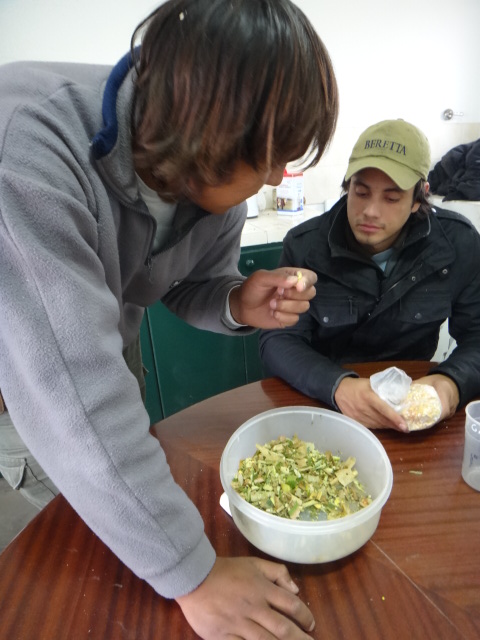

Determining the cost to the company of producing its own silage is a little bit complicated. Since the company also has the option of letting the crop go to seed which it could then sell commercially at a substantial profit, the theoretical production yield of each field harvested for silage needs to be determined by leaving a sample section. Essentially, a sample lot, generally of about 2 hectares, is left unharvested until it is ready to be harvested as corn. The weight per hectare of the corn is then determined for the field in question, and the total potential yield of the field is calculated. The theoretical market value of the field is then determined and charged to the company for the silage.


Corn

Corn is a high energy fodder that finishes the cattle well before being sent to market for butchering. During the growth, the first nitrogen application (NO3) is applied when the plant is between 0-20 cm and the second nitrogen applicaiton is applied when the plant is between 20-60 cm. Phosphorous is also applied as well as organic matter based on the percentages required by the soil. With the nitrogen application, like with all chemical applications to the fields, the quantities required can be precisely calculated. For example, the NO3 in the soil is converted into a total kg/hec and then the application is done to top up the quantity to an amount not to exceed 160 kg/hectare because no additional response is notable past this point. At 160 kg/hec, 10 metric tons of corn is generally harvested per hectare. The nitrogen is applied through urea applications.

For planting, the cycle is generally soil preparation, mulch burning, round up application, fertilizer appication, seeding. Corn is seeded at 5.3 plants per meter. The biggest problems growing corn are corn rust on the leaves, which affects the silage quality but not necessarily the seed quality, and pests such as aphids and schizaphis graminum. Actually it was remarkable to see that every cob (seemingly) had the top born into by a worm and the top of the ear destroyed. Apparently all corn suffers from this pest but the corn and silage is processed with the worms as well - they get sorted out through the machinery.


The loss rate that is tolerable for corn is 3% of a crop. If there is a greater loss, greater intervention need happen.


\

The corn harvester functions similarly to the soybean harvester in that the plants are chopped at their base, the plant is brought into the combine and then the dried kernels are then separated and stored in the storage basin of the harvester until they can be distributed into an intermediary machine before being stored in silo bags.
At the same time the efficiency of the harvesters need to be controlled. I must being by saying that controlling corn is certainly a much more intimidating process that the other crops - the reason is that you first need to mark out a section of the field on which you will be doing your test. While you are in the corn rows, unable to really see where you are or the other people you are working with because the plans are so high, you hear the harvester coming. To prep the test, we need to count how many seeds or ears of corn are already on the ground in the test area. Then befefore the machine arrives, you need to manually rip out the plants from an area so that you will be abe to throw four 1/4 square meter mats flat to various locations under the harvester. It is literally a race against approaching blades of death. Once the harvester passes, the number of seeds above and below the mats are tabulated to evaluate the loss of seed that are being taken in by the machine, separated from the cobs, but then discarded for whatever reason. Then, in the measure area, the number of cobs which are left whole, meaning they were not taken up by the machine, are counted too.


Once the corn is harvested it is brought to an area neighbouring the feedlot where it is processed by a mobile mill and stored in silo bags to be used to feed/finish the cattle in the feedlot throughout the year. The reason the corn is milled is because the cows are unable to properly digest dry corn on their own. By breaking up the seeds, the cows' stomach enzymes are able to better break down the carbohydrates and use the full potential of the fodder being fed to them.


Thursday, May 24, 2012

Life Update: Transitions from Lone Adventurer to Team Awesome

I have been in Vancouver for just over two weeks now. The time is flying by so quickly. I still have information I would like to document from my last weeks in Argentina, so that I can retain the knowledge I worked so hard to gain there, but I am having difficulty sitting down to put the words to paper.

What am I doing? Where am I going? What is next?

Still living out of my backpack, I am currently in Vancouver for a short visit of eight weeks. I am here because my days as a lone travelor have come to an end. Without getting into too many details, a long time friend and I started seeing each other at the end of 2011. We decided that our passions for high-adventure outdoor living, good food, great friends, art, culture, travel, education and our parallel quests for awesomeness in our own lives were something that we wanted to share with one another.

So what does this mean for the upcoming year in terms of adventure?

Starting in September I will be going to UBC to pursue an M.Sc in Soil Science. I am currently working with my research supervisor to brainstorm topics for my thesis. Though there is the opportunity for me to be involved with a project that may be starting in El Salvador shortly, I am leaning towards doing my work in BC to develop better professional networks and cultivate a stronger knowledge base for the work that is being done in soils in BC and/or Canada. There are two federal research stations in Agassiz and in Summerland that have soils labs with whom I am trying to determine a best fit for my interests as well as opportunities for funding for my research. Our soils are our future!

Since Adam is a teacher, he will have July and August off for summer holidays. We will be starting off the summer doing a week-long hike with a group of friends of the North Coast trail on Vancouver Island. Then we will quickly be changing gears and going on another travel adventure to France, Spain, Morocco and London for the 2012 Summer Olympic Games. I am look forward to cheering on friends of mine that are competing as athletes, to experience London after having been a part of Vancouver 2010 and of course to see some great friends now living in the city.

Adam and I will finish in Montreal, where we will get to relax at the farm for a couple of weeks before driving my car and posessions, which my parents have kindly been minding for me during my travels, back across the country to start anew in Vancouver after having left a year and a half earlier.

Time is precious and time is fleeting. This is a reality I feel all too well when living in urban landscapes. These days I find there are many telling signs that time is passing me by: the number of friends' weddings I am attending each year, the number of my friends who have children or children on the way, the number of my friends who own their own homes and even the visible signs that our parents are getting older. Let us not forget the ten year anniversary of our highschool graduation next year or the fact that I have not lived in Montreal for eight years now.

The message I am trying to share is this: take risks on yourself and on others, learn to forgive yourself and others, never stop learning, be open and choose to be happy. These are the challenges I face most often, but they are also the ones that continue to be the most rewarding to undertake.

Until next time everyone, happy travels!

Thursday, May 3, 2012

La Candelaria: Working in the Corral (La Manga)

After two months of working with beef cattle, I still look forward to working with the animals every day. Having no animal husbandry skills previously, I was unsure if I would take to the work or be put off by the idea of treating living creatures as products that are thought of in terms of gains and losses. I can report that today, when I see a cow/steer with well developed muscles, I see asado meat or I see assets.

One of the reasons I have come to love working with cattle is that the work is very involved and constantly changing. For example, generally the work in the feedlot can be grouped into a few categories: 1) receiving calves; 2) tagging and vaccinating calves; 3) sorting animals by weight; 4) separating ill or injured animals for better care; 5) herding animals - herds or escaped animals - into their corrals; 6) tracking and determining the cause of deaths; and 7) advising on nutritional needs for feed.
Though the work in the feedlot is essentially a constant rotation of these categories, the animals, the weather, and the logistics of making the work happen provide enough variation to make the hours pass quickly.

The first day at La Candelaria, I was working with the veterinary interns, Christian and Roberto, and the feedlot gauchos. The first job was for the interns to organize the quantities of vaccinations required for the calves that had just been received. La Candelaria is large enough that they have an extensive stock of the vaccinations, medications and veterinary instruments needed throughout the cattle rearing season - I would refer to it as the veterinary pharmacy.
The pharmacy, for example, has a currnet stock of about $100,000 US of the vaccine Micotil 300, a vaccine that is fatal to humans (which is why I was not allowed to handle its injection), but that is administered to all entering animals, because of its success in preventing respiratory disease in feedlot calves. 


The pharmacy also has a fully stocked walk-in fridge for the antibiotics and vaccinations that need to be kept in cooler conditions.

Like the ethical debates surrounding the use of genetically engineered seeds to maximize production, there too is a debate about the use of antibiotics and vaccinations to maintain the health of animals in feedlots.

All new animals receive about five different vaccinations upon entry. Actually, when the young calves arrive, they are first put into paddocks for five days to recover from the stress of travel. This gives them a chance to build up their immunity in preparation for receiving their vaccinations. The vaccinations depress the animals immunity as well, which is why an immediate application directly after arrival would compromise their health greatly.

I don't know the scientific discourse on the effects of the universal application of vaccination and antibiotics on the long term health of the cattle industry - by this I mean I don't know if vaccinations are constantly having to change to meet increasingly stronger diseases - nor do I know the discourse on the intensification of the antibiotics or vaccinations in humans in societies that consume a lot of beef.

What I do know is that the vaccinations are applied efficiently, universally, and with care. They are applied according to the directions and they are effective at maintaining the health of the animals. I know too that it is difficult to see sick animals and the immediate reaction to seeing a sick animal is to give it something to make it healthy. The point is, that it is not possibly to produce this much meat at competitive market prices without using pharmaceutical support systems to prevent disease. I can report too, that despite the use of pharmaceuticals, there is still a loss of about 2-3% of the animals. This may seem like a low loss rate, but at 50,000 animals approximately 1250 animals will die which translates to about  $1,350,000 lost revenue should the animals have made it to harvest weight. (My calculations are done using the currently live animal sale price of 10 - 15 pesos per kilo, animals weighing about 350 kilos, and an exchange rate of 4 pesos to 1 dollar.)

To be closer to reality, it is important to remember most animals don't die weighing 350 kg.  Most die because of the cold, they are unable to adjust to the eating regimes of the feedlot, weak immune systems and disease. This happens most often when they are young and closer to 120 kg. The animals that do die are tracked and photographed in order to be able to recognize trends in the losses. As well, the veterinarians sometimes do autopsies on the bodies when they are unable to determine the cause of death in a seemingly healthy animal.


Tagging is quite important for traceability. The animals for which numbered tags are drawn up - one of my main duties in the corral - are traceable all the way through production. These animals are the ones that will be exported to Europe for consumption, where traceability is required in order to ship the animals beyond the Argentinian border. The animals that stay in Argentina, are not tagged for traceability, as there is no reason to put in the extra work.


When calves are being received in quantities of 500, 1000 or 1500 per day, it takes a strong team that knows what they are doing to prep the animals for their lives in the feedlot. These men also need to make sure they are making their lives easier and safer in the long run. One of the most common dangers dealing with steers and cows are their horns, which is why those that arrive with horns quickly have them cut off. Though there is a lot of blood, the horns come off pretty easily. We  made sure to restrain the animals securely when I gave it a try.


When calves arrive, they are not used to being caged-in, since most come from extensive ranches where they roamed freely with their mothers. For this reason, dozens of animals escape from their paddocks daily, which then need to be returned to their proper location by the gauchos. With 150 paddocks and growing, it is a job that requires time and precision to ensure the animals are exactly where they need to be. I quickly learned, that keeping the animals caged and neatly ordered is never a reality. Here are a couple of the guys that make it happen!


Tuesday, May 1, 2012

La Candelaria: Seed Storage, Old and New

Storage technology for seeds has changed drastically in the last decade. Previously, all seeds harvested had to go through a mechanical silo plant (shown below) to be dried, fumigated for pests, separated, stored or loaded for shipment. This technology, though effective, was very time consuming and costly. For this reason, the silos here are used almost exclusively for storing feed for the feedlot today - namely corn, sunflower pellets and sometimes soy.


Though the plant manager, who knows the silo system inside and out after 20 years of employment at La Candelaria, he admits that the technology is now considered archaic. Today massive industrial plastic bags (silo bags) are used to store seeds directly in the fields where they are harvested or wherever you would like to lay out the bags. For example, much of the corn that is harvested is transported to a storage area beside the feedlot where the corn is first milled before being put in the storage bags.

The technology does save transportation costs, maintenance costs for the storage medium (since it is only used once no maintenance is required), and is very flexible on space. Using the bags, it is important to ensure that the crop is fully dehydrated before storing, since it is no longer subjected to drying after harvest. However, since there are no longer storage constraints in terms of volume, the flexibility to harvest when the crop is ready is more easy to achieve.

Once major challenge with the bags that was an obvious advantage of the mechanical system is that the harvested seeds are no longer fumigated for bugs, which have been able to proliferate in bags under the right conditions. Technologies to fumigate the bulk seed when it is being removed from the bags into trucks to be sold is being developed.


Another problem with the bags is overfilling the bags beyond their capacity. For this reason, each box the bags come in, has a measure stick that can be compared to the marked areas on the bags to ensure the stretch is within the tolerable limits. If not, the bags and accordingly its contents, are at a higher risk of experiencing breaks or being penetrated.


Monday, April 30, 2012

La Canderia: Wheat (Trigo)


There are currently prohibitions from exporting wheat in Argentina, which has given the three or four larger wheat mills the power to control the price of wheat in the country.  For this reason, wheat is planted annually at La Candelaria for the sole purpose of seed preservation for the time that the market price goes up or the export prohibitions are lifted.  The world market for wheat is currently around $180 per metric ton, and in Argentina wheat is selling for closer to $80-$100 per ton. In 2011, the loss on the wheat production at La Candelaria was 13%.

Seeding occurs in June and harvesting in December. It is ideal to seed when the conditions are dry to prevent the seeds from absorbing moisture, freezing and losing their ability to germinate. Furthermore, the reason that wheat is most often planted after a soybean harvest is because the mulch that remains after a maize harvest retains too much moisture thereby increasing the freezing probability of the seeds.  Wheat yields are on average 3300 kg per hectare, are at their highest at 5000 kg per hectare, and are around 1800 kg per hectare when the seeds are subjected to a frost.

The seeds have a fungicide treatment applied pre-planting to protect against fungi in the soil. About 600,000 seeds are planted per hectare, and each seed grows into 3-4 wheat shoots. Herbicide is applied during the seedling phase, and then a second fungicide is applied in the second to last phase of the growth cycle to prevent roya (rust), a fungus that affects all the crops harshly. Other pests include caterpillars.
Since wheat is returning such a low value in Argentina currently, decisions for chemical applications need to be carefully calculated. Direct applications – ones done on the ground by tractors – result in an automatic 5% loss of the crop because of the damage done by the tractor tires. Aerial applications on the other hand are much more expensive. So, the yield of a crop must first be determined to see if more will be made from the crop using an aerial or direct application. Generally, if it is a productive field, the application is done by plane, and if it is a non-productive field, the application is done on the ground.
Harvesting wheat is similar to other grains. The controls are similar too – 333 grains per square meter equals 100 kg per hectare.
Wheat can be used for a number of markets. Wheat can be used for fodder, wheat pellets can be produced as a by-product during wheat processing, and wheat is used widely for human consumption.  Two common seed varieties used are baguette 11 and cronox. The problem with producing higher value wheat varieties, is that the market to get back your money doesn’t always exist at the time of harvest.

Sunday, April 29, 2012

La Candelaria: Precision Agriculture

La Candelaria consists of 118 lots which are constantly being seeded, receiving chemical applications, being monitored for humidity, temperature variations, topographical changes, or being harvested. Understandably, with approximately 12,833 hectares being cultivated, there is always work to be done by the agricultural division.

Currently, the team is in the first steps of developing an online geographic information system (GIS)database to improve their knowledge of their fields and thereby improve yields. This was my first introduction to precision agriculture.

There are a number of variables that exist within fields. By doing landscape analyses of the harvest yields annually, slowly a landscape inventory of the variations in the fields' productivity is being developed. Currently the project is in its third introductory year. In 2010, the first harvesting machines with the ability to track and document the quantities being harvested at precise locations for each crop. The ability to track this information has been made possibly by using GPS technology amongst others. The following year, in 2011, pretty much all of the machines had the technology to capture the precise yield information more fully, though some holes still exist.


Here’s how it works. First the raw data is exported to the company's network in the office. The raw data then needs to be input manually into an agricultural software called SMS by Ag Leader. The information currently needs to be input manually for two reasons. 1) Unfortunately, the GIS software systems for each of the major agricultural mechanical manufacturers - John Deer, New Holland, Claas – are currently incompatible, and since contrators don't all use the same mechanical brands to harvest, the administration needs to assimilate the information themselves. 2) La Candelaria developed a lot (field) numbering system to organize the land being cultivated over many decades. This information isn't currently represented in the collection software by the mechanical harvesters. For this reason, the administration needs to identify and label each lot manually when inputting the data into the SMS system so the information can be appropriately referenced.

Once the information is in the SMS system, different variables can then be isolated and mapped for analysis. Though the software is complex enough to map very precise variations, currently the administration is creating maps with three colour variations for simplicity - green, yellow and red. Using the mapped out yields, it is then the task of the administration to determine if the lower yields are because of humidity, pests, disease or other factors.

About five years of information is needed on a field before any major decisions can be taken since weather changes from year to year and the overall climatic conditions of each year also need to be considered for yields.

Ultimately, the assimilated field variation information will be able to be transferred to the seeders, fertilizers, and fumigators to improve the efficiency and precision with which chemical applications are dispered or seed varieties are chosen to meet specific growth conditions. The goal with precision agriculture is to take advantage of modern agricultural technology to maximize production. For example, there are machines that currently use ‘green technology’ when fumigating, which means the machines have the ability to detect weeds and apply herbicides only in the locations where weeds are growing. I am very impressed to learn about such technologies, as I was under the impression that most often chemical applications were spread across the entire field regardless of need. Though I do not know the commonly practiced methods in Canada and the US,  this technology is certainly more cost effective and more environmentally friendly.


In these first years, a major challenge has been that not all contractors have the technology in their machines to map the fields. Also, some don’t have the proper training to make sure the information is being collected properly. This has resulted in discrepancies from year to year. One of the responsibilities of the agricultural division during harvest season is to be on top of which machines have the technology and to calibrate the machines, which takes about 20 minutes, once a week to ensure the information being collected is accurate. For the agricultural division too, learning to apply the technology takes time. Ag Leader provides a trainer that comes in to improve the capacity of the administrative team on its software. However, scheduling and finding time amongst the other responsibilities on the farm is often difficult.

To test the technology, the administration has conducted experiments on certain lots. For example, on one sunflower lot this year they applied fungicide in its usual dosage on half of the field and didn’t apply anything on the other half. Come harvest time, the sunflowers that had received the application yielded 400 kg more per hectare. The lot was 92 hectares which means about 18,000 kg of seed were lost on the 45 hectares that didn’t receive the fungicide which is certainly significant.

Last, the raw data that is being collected by the harvesters is currently being archived in case one day a program that can process and interpret all the mechanical manufacturers' systems is developed, La Candelaria has its history available and can be ahead of its competition.

La Candelaria: Sunflowers (Girasol)


Currently there are no lots planted with sunflowers. Seeded in October/early November and harvested in February, approximately 400 hectares of sunflowers are planted at La Candelaria annually. Like corn, sunflowers need to be bought annually because their specific genetic properties terminate after one growth cycle.

The fertilizer requirements for sunflowers are 80 kg of nitrogen and 12 kg of phosphorous per hectare. If the specific field where the sunflowers will be planted already has adequate amounts of these two nutrients, no application is necessary. The sunflowers are most sensitive during their flowering phase when the pollen is susceptible to being lost from the plants. For this reason, the ideal time for flowering is December 15 – January 15 when there is little rain to disturb the pollen. The plants flower about 80 – 90 days after seeding. During the germination phase, the plants are sensitive to ants and freezing.
About 40,000- 65,000 seeds are planted per hectare. A minimum of 40,000 plants are desired per hectare. Sunflowers are competitive plants, which means to have each seed produce the biggest flower and therefore seeds, enough light, nutrients and water needs to be available to each plant.

Nitrogen is applied when the flower starts to emerge and a preventative fungicide is applied before the flower opens.

The reason sunflowers are planted in such limited quantities is that their price is controlled by the Argentinian processing plants that buy the seeds.