People sometimes wonder how I became interested in food systems and agriculture since I grew up in Montreal and then moved to Vancouver - two significant urban centers by Canadian standards.
Well in Quebec my grandparents invested in farmland in the Laurentians many years ago, and so both my father and uncle, and then my brother, cousins and I, spent a significant amount of time at the farm. Somehow, that place has had a strong influence on a number of us. My father now runs that farm passionately, and my uncle is successfully producing wine, cheese and even chickens in the Niagara region of Ontario.
Check out his winery, Hidden Bench, and the fantastic reviews it is receiving.
Monday, September 17, 2012

Thursday, September 13, 2012
Report on Science
I have recently returned to school to pursue a Masters in Science in Soil Science from the University of British Columbia. While trying to adjust to a life that is indoors, stationary and of the mind rather than of the body, I have been struggling to understand what it means to be a graduate student and what it means to be a member of the scientific community.
I once did an art project for a class on the history and philosophy of environmental thought, where I compared the way we view western medicine (science) and the way we view Christianity (religion). The point of my project was to challenge viewers to think about, or even possibly concede, that science is as much a belief system as religion - in a way it is our modern day religion. There exists the practice where the majority of the general public put faith in the methods and practices of science in order to facilitate their adherence to the rules and results put forth by the scientific community - much the way people adhered to the Christian faith many years ago. Believing in science requires faith in the practitioners who deal with scientific methodology, processes, subjects and research on a daily basis. However, like all human creations, science is flawed because of its human component. Practitioners are only human, and they make mistakes. This realization is often disheartening for non-practitioners.
This week I learned an interesting fact about scientific publication. Perhaps part of the reason we believe that science is such a majestic entity is because the scientific community is in the habit of only publishing positive results. What this means is that though there are many research projects that turn out to be complete flops, no knowledge, methodology or results are shared from these misguided pursuits of answers. What this also means, is that the same questions can be asked again and again because there is no record that someone else has gone down the same road in another place or another time.
To counter this trend, I have also learned of the Journal of Negative Results. "The primary intention of Journal of Negative Results is to provide an online-medium to publish peer-reviewed, sound scientific work in ecology and evolutionary biology that is scientifically rigorous but does not rely upon arbitrary significance thresholds to support conclusions." (http://www.jnr-eeb.org/index.php/jnr/index Sept. 13, 2012)
The element which most surprises me is that until this moment, I had never thought about what were the biases for publication in scientific journals. Even something as simple as highlighting positive results and omitting negative results is significant.
We must ask then: Do readers prefer reading about success rather than failure even though failure is just as important as success?
I once did an art project for a class on the history and philosophy of environmental thought, where I compared the way we view western medicine (science) and the way we view Christianity (religion). The point of my project was to challenge viewers to think about, or even possibly concede, that science is as much a belief system as religion - in a way it is our modern day religion. There exists the practice where the majority of the general public put faith in the methods and practices of science in order to facilitate their adherence to the rules and results put forth by the scientific community - much the way people adhered to the Christian faith many years ago. Believing in science requires faith in the practitioners who deal with scientific methodology, processes, subjects and research on a daily basis. However, like all human creations, science is flawed because of its human component. Practitioners are only human, and they make mistakes. This realization is often disheartening for non-practitioners.
This week I learned an interesting fact about scientific publication. Perhaps part of the reason we believe that science is such a majestic entity is because the scientific community is in the habit of only publishing positive results. What this means is that though there are many research projects that turn out to be complete flops, no knowledge, methodology or results are shared from these misguided pursuits of answers. What this also means, is that the same questions can be asked again and again because there is no record that someone else has gone down the same road in another place or another time.
To counter this trend, I have also learned of the Journal of Negative Results. "The primary intention of Journal of Negative Results is to provide an online-medium to publish peer-reviewed, sound scientific work in ecology and evolutionary biology that is scientifically rigorous but does not rely upon arbitrary significance thresholds to support conclusions." (http://www.jnr-eeb.org/index.php/jnr/index Sept. 13, 2012)
The element which most surprises me is that until this moment, I had never thought about what were the biases for publication in scientific journals. Even something as simple as highlighting positive results and omitting negative results is significant.
We must ask then: Do readers prefer reading about success rather than failure even though failure is just as important as success?
Tuesday, July 24, 2012


Essouaira (Pictures to follow)
Adam turns to me and says, “Is it just me or has Morocco started to
lose some of its charm?” I agreed that the novelty we felt in the first few
days of our visit to Morocco had started to wear thin. We had arrived in Essouaira,
a fishing port town on the Atlantic, and were not impressed. It was admittedly
nice to be in a new city and one much smaller and with wider streets, which
made navigation much easier. Also, since we were on the ocean, the weather was
much more bearable – the temperature had dropped from 40 C to 22 C.
The first night we walked the medina in search of food. Unfortunately,
my stomach was already queasy from the dinner I had cooked the night before,
and after the 7 hour train ride without air conditioning through the dessert,
followed by the 2.5 hour bus ride, I was not eager to put up with the sales
people of the medina. We thought our search for a restaurant would be short,
but we unfortunately went what turned out to be the opposite direction of the
main restaurants in our search. Along the way, we passed many vendors and then
arrived at a very dodgy gate to the medina where there were homeless begging
for what coins they could and hiding in the dark corners making ready for the
night. I was put off by the scene at first because of the hassle, but when I
saw a man lying on the ground using his open wound on his leg which looked like
rotting flesh for money, I was immediately disgusted. Outside the gates our search for food did not
meet much more success, and at this point our nasal cavities were being
bombarded with the stench of sewer water in the street. On top of that there
was garbage everywhere – pretty much as there has been across the entire
country in both urban and rural places. I hate to say it but Essouaira is
dirty. My appetite was gone. I was ready to call it a night.
The next day we started afresh. We first had breakfast on the rooftop
of our riad followed by a walk under the blue sky to the fishing port. There we
visited the fishing market which was full of an equal amount of hustle and
bustle as the medina store fronts – one thing both Adam and I will attest to is
that Moroccan’s work hard. We then walked through the boat repair port where
boats where hulls for big fishing boats were being cut crudely in wood. And
last, we continued along the beach which is the main draw for tourists to
Essouaira.
The beach was nice and not too crowded swimmer wise, which makes sense
in a Muslim country, however, the commerce on the beach was aplenty. You could
windsurf, kitesurf, surf, camel ride, horseback ride, ATV tour, get henna
tattoos, rent umbrellas and lawn chairs, and find plenty of dining.
We looked into Adam going kitesurfing, but the prices were similar to
those in Canada, and I didn’t think he would get as good a service as he would
back home. Instead we had a nice lunch, before I was again ill. It was at this
time that Adam and I had to concede that maybe Morocco had caught up with us
and was possibly kicking our butts.
My travelors gut was not getting better but worse, and he was feeling
tired and wanting to get out of the sun too. So we decided since Essouaira
didn’t have as much to offer as we hoped, we would take the afternoon off and
escape into our hotel. It was a good plan until we ventured out to dinner and
the restaurant we chose had bugs crawling everywhere, the food was half cooked,
and I again got ill.
Not feeling the draw of the city so many other tourists had also
flocked too, we decided it best to leave and start afresh in Marrakesh. Before
we left the seaside though, we did make a point of taking a camel ride along
the beach and sand dunes. The camels are really impressive creatures. Much
larger than I had thought them to be, I think the humour in their character put
Adam and I both in good spirits again.
Fes: Part II (Pictures to Follow)
Wednesday and Thursday were spent exploring the medina in Fes. We
started off with guided tour from an official guide through our hotel. His name
was Khalib. Khalib took us around the Fes medina, a medina that is very narrow
and maze-like, to show us important historical buildings as well as culturally
interesting markets within the medina walls. We started at a former religious
school where Khalib talked to us a little about his religion as well. There are
many rules for Muslims and I think the most important advice he gave to Adam
and I was not to judge the Islam faith by what other Muslims do, but to always
judge the religion by the example given by the prophet Mohammed. All Muslims
should lead their life following the Prophets example, but of course no man or
woman is as true as Mohammed. No one can love as deeply, be as true, be as
humble etc.
The different souks, markets, were probably the most interesting. Again it is difficult going anywhere in Morocco without having goods pushed on you, especially if you are being brought there to learn a little about the industry, there is always an expectation for you to pay back the information you have gathered with a purchase – for which your guide, no matter how official, will always receive some sort of commission. We visited food markets where dates, nuts, fresh fruit (oranges, grapes, cactus fruit), butchers, live chickens and rabbits, and olive sellers lined the streets. We visited the tannery section where the smell alerts you that you are in the presence of some intensive chemical transformations. (Adam was keen on getting a closer look than the bird’s eye view we received on our official tour and was able to sneak into the tanneries on two occasions in the next day.) We visited a section of the medina where all the shops are for the wedding ceremony – in Morocco, the bride and groom sit on very large white or gold thrones during the wedding ceremony that can be rented. The clothing is all white and gold too and very beautifully woven. Even the marriage proposal is elaborate. The prospective groom collects a basket of goods – dates, jewellery, scarves, special cakes – and marches them down the street in a procession with music to the house of his desired bride to ask her for her hand in marriage. Beforehand he would have asked the father for permission to do the procession. The reason that everything is so public is so that the neighbours and the neighbourhood know the intentions of boy and girl and do not start talking badly about their relationship because of misinformed.
Adam’s nightly adventures included a cute story about him getting involved with a group of children which we have since deemed the ‘ninja kids’. It started off with Adam walking down our alley and coming across some of the local kids. Being a teacher, Adam always says hello to kids and likes to interact with them in an energetic kind of way. At this time, one of the boys has picked up a friend and was about to body slam him onto the ground. Adam told them to be careful and asked if they were ninjas. Well the kids loved the ideas of being ninjas and started kicking and bouncing off the walls and even Adam. When he tried to end the interaction and get the kids to back off, it was too late, they were ninjas. So the group of children chased Adam down the alleys attacking him like ninjas as he tried to convince them the game was over.
The different souks, markets, were probably the most interesting. Again it is difficult going anywhere in Morocco without having goods pushed on you, especially if you are being brought there to learn a little about the industry, there is always an expectation for you to pay back the information you have gathered with a purchase – for which your guide, no matter how official, will always receive some sort of commission. We visited food markets where dates, nuts, fresh fruit (oranges, grapes, cactus fruit), butchers, live chickens and rabbits, and olive sellers lined the streets. We visited the tannery section where the smell alerts you that you are in the presence of some intensive chemical transformations. (Adam was keen on getting a closer look than the bird’s eye view we received on our official tour and was able to sneak into the tanneries on two occasions in the next day.) We visited a section of the medina where all the shops are for the wedding ceremony – in Morocco, the bride and groom sit on very large white or gold thrones during the wedding ceremony that can be rented. The clothing is all white and gold too and very beautifully woven. Even the marriage proposal is elaborate. The prospective groom collects a basket of goods – dates, jewellery, scarves, special cakes – and marches them down the street in a procession with music to the house of his desired bride to ask her for her hand in marriage. Beforehand he would have asked the father for permission to do the procession. The reason that everything is so public is so that the neighbours and the neighbourhood know the intentions of boy and girl and do not start talking badly about their relationship because of misinformed.
The jewellery in Morocco is very beautifully crafted. Mainly with
silver and stonework, the designs can be very elaborate. I have purchased a
couple of pendants to wear, and it is hard not to bring more home with me…that
is until I have to engage in a haggling war with the shop owners. (In fact the
place that I bought my two pendants is from some young guy with a big African
afro who tells you up front and he even has a sign in his store that he does
not negotiate on his prices. It was quite a relief to hear a price and either
accept the price or walk away without discussion.
When I thought about Morocco, the first thing that came to my mind in
the past were bountiful colours in the markets. I was very pleased to discover
in Fes that the colours are in fact a very real part of the Berber culture.
When we visited a weaving cooperative, it was beautiful to see the many dyed
silks, cottons and wools that had been woven into blankets and scarves. Though
we knew we would be paying a little bit more to have seen where the pieces were
made, Adam and I couldn’t resist and purchased a couple pieces for ourselves.
The excitement and hustle and bustle of the Fes medina markets are
definitely worth a visit. Anything you could want is on sale and you will
definitely feel very close to Moroccan culture walking through the narrow
streets surrounded by the sounds, smells and sights that Morocco has to offer.
The only problem is that after a couple of days, not only does the novelty of
the place wear off a little, but the fact that you can no longer walk down the
street without the vendors remembering your last conversation and asking you if
it is indeed now that you will come and ‘just look’ at their goods, or if it is
now that you will talk about ‘your best price’ for something in which you had
shown a faint interest. Honestly, it all gets a little tiresome. (Or as I would
discover toward the end of my trip, the constant selling gets very tiresome.)
Though we were able to pay our guide and escape to a lunch of our own
choosing – a full couscous lunch with appetizer olives and bread and a big
bottle of water for less than five dollars! It is these prices that make-up for
any downsides that we experience .
In the afternoon, we continued to shop a little more and then ventured
to the train station to try and get a refund for our train tickets to
Casablanca we were no longer going to use. Surprisingly, we did get an 80%
refund without too many questions. However, when we tried to book our next
ticket for Friday, we were told that we couldn’t because the train master was
not sure of the train schedule for that day since it was the day leading up to
Ramadan. Ramadan is the holy month for Muslim people where they must fast, both
food and all liquids, all day long. Some interesting facts about Ramadan are
that for women, if you are pregnant during Ramadan, you don’t need to fast for
the sake of your health and the health of the baby, but once you give birth,
you must make up the time. Also, the week women have their period during
Ramadan, they don’t need to fast, but at the end of the month, they need to
make up the week as well.
Not exactly understanding how the start of the religious month would
affect the train schedule, we just had to accept that it did, and buy our
tickets on Friday when we arrived.
In the evening, Adam got a very cheap and very well groomed haircut,
while I got my hands covered in Henna.
Our dinner was on the rooftop of one of the medina buildings. We entered
the first restaurant and climbed to the top before Adam saw that there was a
higher rooftop across the street. Then once we had been seated on that rooftop,
he spotted another higher one, but we stayed where we were….Though that
restaurant was one of the first where we started to questions the cleanliness
of Moroccan service.
Adam’s nightly adventures included a cute story about him getting involved with a group of children which we have since deemed the ‘ninja kids’. It started off with Adam walking down our alley and coming across some of the local kids. Being a teacher, Adam always says hello to kids and likes to interact with them in an energetic kind of way. At this time, one of the boys has picked up a friend and was about to body slam him onto the ground. Adam told them to be careful and asked if they were ninjas. Well the kids loved the ideas of being ninjas and started kicking and bouncing off the walls and even Adam. When he tried to end the interaction and get the kids to back off, it was too late, they were ninjas. So the group of children chased Adam down the alleys attacking him like ninjas as he tried to convince them the game was over.
On his way home too, he met another little boy that told him, “Sir. I
know from your language you must be lost.” He didn’t want to tell the little
boy that he has never really been lost.
The last day was like the others, except for our visit to the Hammam
and my decision to cook dinner at home in the hopes it would be cleaner than
the last places we had visited and we could try some of the flavours and foods
we had walked by the days before. Eating in foreign countries there is always a
risk to get sick, but I made sure to cook everything to be piping hot before
consuming it, still, I think this dinner was the cause of my travellor’s gut in
the coming days. I don’t know exactly what it was, but I go progressively more
sick in the following days until I couldn’t keep any food down more than 15
minutes after eating.
I guess after having no problems doing similar meals in central and
south America in recent years without issue, I thought it would be fine, but
even buying our food wholesale, I knew we were getting ripped off. Lesson learned.
Saturday, July 21, 2012
The Hammam: My experience getting a massage from a topless old woman in Morocco
In Morocco there exist public and private spas in most communities
which are called Hammams. Each day, the facilities are open in the morning to
men exclusively, the afternoon women exclusively and then later at night men
again exclusively. The spas are used as a sort of public bath where men and
women have the facilities including cold rooms and hot steam rooms to bathe
themselves thoroughly. There are also services offered such as massage and
bathing.
Services in developing countries are always very affordable, so Adam
and I decided that it would be silly to turn up such an inexpensive ‘massage’
even though we had no idea really what to expect on the inside of the Hammam. I
went first in the late afternoon. I walked into the Hammam and was met by a
room of Moroccan woman only one of whom spoke a little French. She said the fee
would be 120 Dh for the full massage and bath. (This was another situation
where I was given the tall white girl fee, but honestly the price was still 5
times less than what I pay in Canada so I couldn’t really complain.) Next I was
told to strip down to just my underwear while a very old woman was called down
from upstairs. The woman, wearing only a black pair of underwear and a while
head towel, came to me and grabbed my hand like a child to lead me into the
bathing room. She grabbed a plastic mat for me and laid it down on the tiled
floor next to a collection of large green buckets. She rinsed off the mat and
floor and told me to sit while she went to get the supplies. (The old lady did
not speak any French, so our entire interaction was through hand signals and
eye contact for the duration of my experience.) As I sat in the room, I was
able to watch some of the other women bathe. Most bring their own supplies and
even their daughters which appear to be used as the water collectors filling
the bathing room buckets with either hot or cold water from the hot and cold
rooms as their mothers demand.
The old lady came back with a small plastic stool, a tub of dark brown
balm and a scrubbing glove. She started by having me sit with my back facing
her to undo my hair and cover me with water. She then brushed my hair out, then
moved into soaping me down, then scrubbing me down for the best exfoliation
I’ve probably ever had, and last she had me lay on the tiles for a massage
before rinsing me all down again and then braiding my hair into an up-do in the
Moroccan style. The whole experience was quite refreshing. It was fun to
constantly have someone poor water onto you and to clean your skin so well.
(It’s gross, but she even showed me all the skin that she had rubbed off of my
body.) It was also neat to be welcomed into the presence of so many Moroccan
women who are typically completely covered in such a vulnerable situation.
I enjoyed the experience, but I could definitely see how it might not
be so comfortable for other women. You walk into a public institution and are
immediately naked with strangers. Then, since we don’t have the custom of
bathing one another in Canada, being scrubbed all over your body could feel
inappropriate. Plus, the person doing the service is naked (and an old lady
too) so the close proximity to another person under such circumstances could
also be uncomfortable. Last, the massage is done on the tiled floor which isn’t
exactly the cleanest – it’s like laying on your stomach on the floor of a
public shower floor to get a massage.
Still I highly recommend the experience for other women travelling to Morocco.
Adam’s experience being bathed
by an old Moroccan man
Adam went to the Hammam after I, not sure exactly what to expect for
the male version of the experience I had described to him. When he walked in,
he was more brave and asked for the Moroccan rate of 60 Dh for his visit though
the best they would give him was 70 Dh. He then stripped down to his underwear
and an old man that Adam describes as being ‘near death’ approached him. Adam
was immediately suspect as to how this old sack of bones was going to be able
to provide an adequate massage experience, but was more than surprised with the
service he received.
According to Adam, as soon as the two were in the bathing room the old
man starting barking commands in Arabic at Adam and pushing him around into
contorted positions. The way Adam tells the story he swears the old man must
have some sort of specialized training or he is either a former Moroccan
wrestler, because the positions into which he was able to force Adam’s body had
him both yelling out in pain and drooling in pleasure simultaneously. After the series of contortions finished,
which lasted about 15 minutes, Adam was happy that the man hadn’t dislocated
any of his joints, and was able to take full pleasure in the scrub down he
received while laying on the tiled floor.
The last part of the male Hammam experience was for Adam to be soaped
down and massaged simultaneously. There was some confusion about this last
part, because though I was provided with soap during my visit, it is standard
for individuals to bring their own soap, and Adam had had difficulty communicating to the old man that he did
indeed have soap. Adam was then rinsed off and dismissed a new man.
Though more painful than he had anticipated, Adam too would highly
recommend the Hammam experience for other men travelling to Morocco.
Fes, Morocco: Part I
Tuesday afternoon we took the train from Tangier to Fes. We opted to
take first class as it was only three Euro more than the second class rate, but
we have quickly learned that the reason there is little price difference is
because there is also little difference in the quality of the ride. Air
conditioning is something that is definitely a luxury if you are able to locate
units that work – we have not been so lucky.
One of our biggest struggles, especially upon first arriving and
especially for Adam, was that there are different prices for foreigners and
that there didn’t seem to be a way to get around it as soon as we were seen. On
the train he was reading about Fes and started to get upset that I had already
booked our accommodation in advance for the rate that I had
($23.33/night/person) because the book said there were much cheaper options. I
said that there were indeed other options that were cheaper, but that I had
done my homework and this place would be worth the money. It was quite a
frustrating argument on both ends because I was unwilling to back down from
staying at the guesthouse as it was the one I was most excited about, I had
spent a lot of time finding it and making sure it would meet our needs, and I
knew that Adam would be really impressed once he saw it. For whatever reason,
he was unwilling to concede to me and I was making it worse by telling him that
I had arranged for someone to pick us up and take us to our accommodation for
five times the taxi rate, which was still only six dollars.


On the train, we sat with a man from Senegal, who was doing a
pilgrimage to Fes to a very important mosque for the Muslim people from his
country, and a recently married couple and the groom’s sister. Some interesting
stories include the Senegal man sharing that he used to spend much more time in
Morocco, but so many Moroccan’s insulted him to his face not realizing that he
spoke Arabic, that he couldn’t endure the hostility. The married couple were
interesting to observe. The bride had her hands and feet covered in Henna, and
all three from the wedding party still has sparkles on them. Adam on our train
ride had to sew his shorts because they had gotten too big and as he was asking
me how he should go about doing the job, the Moroccan man said to his sister
and newly wed wife that sewing is the woman’s job not the man’s. They immediately
retorted to him that that is what Arabic men think, but it is not the same in
other cultures in the world. I said to him that women often do sew as well, but
in this case it was a challenge Adam was taking on himself.
Adam also made some friend on the train – friends whose authenticity we
would later question. Apparently Adam approached this young guy who spoke
English really well and they hit it off. Adam later came to me to say that the
guy had offered to show us around Fes for free and he needed our hotel name. I
gave it to him, since Adam was our official scammer judge. However, then the
guy wanted our address. I gave it to Adam too. Then he wanted to talk to me,
which I had no interest in doing, since I am now suspicious of all Moroccan’s
and choose to follow’s Adam’s lead – if he wanted to go with the guy I would
follow, but I wasn’t going to do any more.
When Adam came back to ask me what he thought, he shared that the guy
also has a cousin in Toronto with whom he spoke on the phone. I said honestly,
that I did not feel comfortable giving the address to our accomodation to a
stranger that we met on a train, but that I did not interact with the guy. If
there was one thing I learned in South Africa, is that people use your
information to take advantage of you, and now this individual knew where we
were staying, and even if he did show us around the following day, what was
stopping him from calling his buddies to tell them that all our things would be
unattended in this space.
I immediately saw the wheels in Adam’s head spinning. Within a few
minutes he had decided that even though his bud had given every impression of
being a good guy, it would be better to blow him off. Still the guy was
persistent trying to make plans with us for that evening and the following day.
His pleas to me were met with denials as I just wanted to rest that night. Adam
was clever in saying that we would call him to confirm the plans if they were
on, which his buddy didn’t like so much. But then when we got off the train, we
did remark it was strange that the buddy didn’t have any luggage.
When we got to the guesthouse where we were staying, it was amazing
that the owner told us a story about how two New Zealander guests of his had
met a man on the train over the previous week and had agreed to go on a tour
with the buddy they met. The buddy even had friend from NZ that were in town
(our buddy also had a Canadian friend that was going to come along). They did
the tour and long story short were scammed into buying $3000 worth of carpets
and switching accommodation only to reveal this to our guesthouse owner once
they realized they were in trouble a few days later. Nothing could be done.
Adam and I kept our mouths shut about our encounter and were glad we had
decided to blow our buddy off.
However, as soon as we arrived and started our drive through the
complicated city, then had to get out and have our driver walk us through the
maze-like alleys to our guesthouse, Adam apologized and said it was better we
had had the driver come for us. Then, when we were met by the British owner of
the guesthouse in which we were staying, Riad Dar Houdou, a 200-year restored
courtyard house in the heart of the medina, and were given our room on the top
floor, the only air conditioned room, that opens up to a terrace that overlooks
the skyline of the medina, Adam was quickly giving me puppy dog eyes knowing
that he was in trouble. He loved the place like I knew he would! So much so
that within ten minutes, he had decided it might be nice to skip Casablanca and
stay an extra night at Dar Houdou, which we ended up doing in the end to take
advantage not only of our great accommodations, but also the expertise of the
trustworthy staff at the guesthouse.
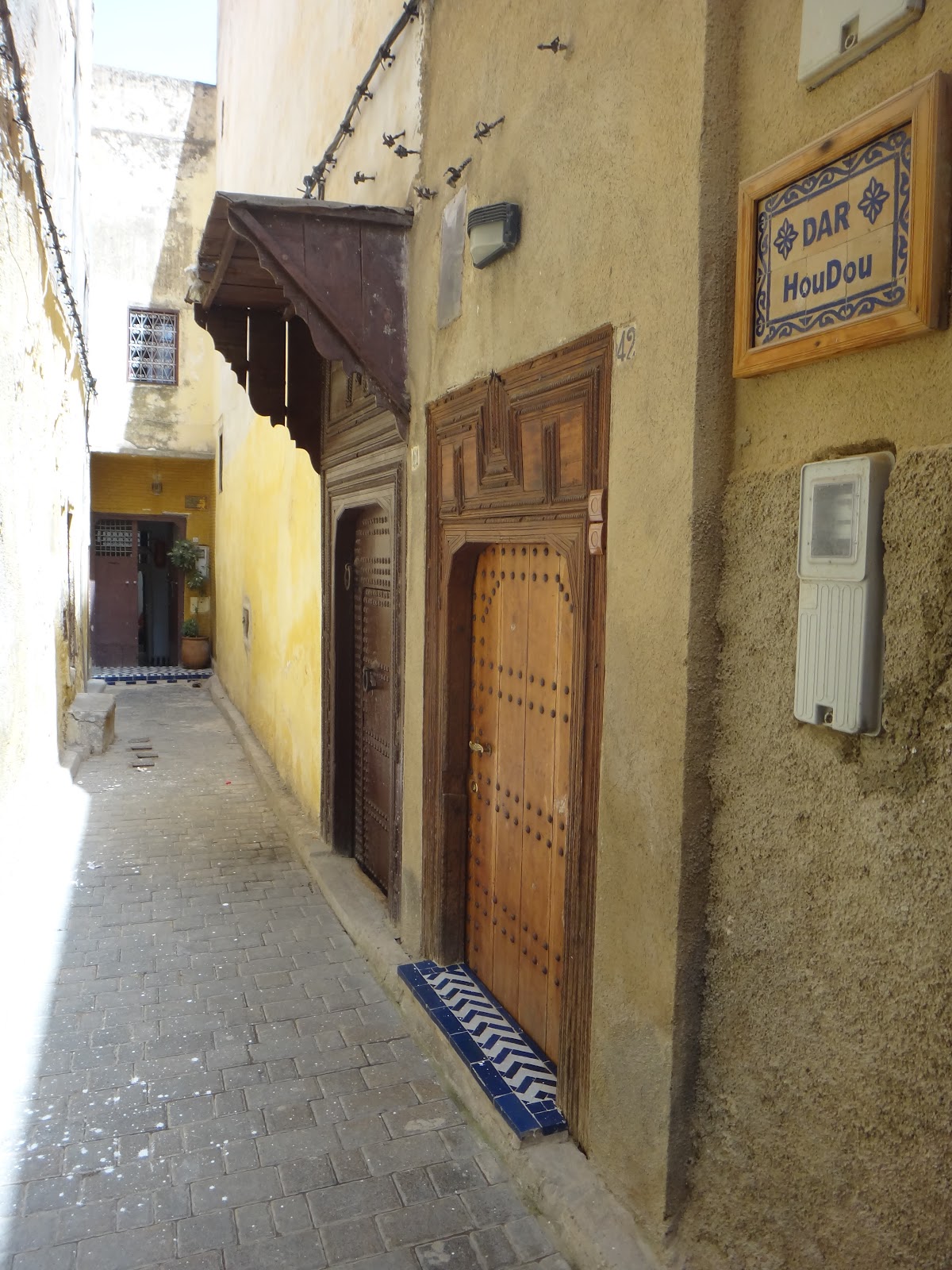


The walk to our guesthouse had been such a teaser for the plethora of
culture that lay beyond the walls of our guestroom that we quickly were out
looking for dinner. Our first night, we enjoyed two three course meals at a
fabulous restaurant in the medina for less than $20. The prices, even if more
than the Moroccan price, are still very reasonable. After we walked for a short
while seeing some of the stalls and getting our bearings, before I had to go to
bed. Adam then ventured into the night to explore. The door didn’t have a lock,
so he had locked me into our room, which was fine by me for the first night,
until I realized that Adam hadn’t taken the name of the guesthouse, the map,
the book of Morocco or even a phone number with him! I couldn’t sleep convinced
that he was going to get lost in the Medina, even though I was trying to
convince myself that even if he did have to stay out all night, that wasn’t the
worst thing and he would be found tomorrow once everything opened again. Though
he did get ‘lost’ in the sense that he was on streets he had not visited
before, he found his way home knowing the general direction of where to go.

His adventures on the first night had included visiting a pool hall,
making friends with many of the young men that hang out in the street after the
markets close, seeing how the medina (old city) changes from a bustling place
of commerce when the sun is up to a venue for young men to smoke hashish at
night, and as a foreigner, apparently he was constantly receiving offers to
partake, which he had to refuse.
Despite venturing the very narrow and dead-end ridden streets in the
dark, Adam says that he always felt very safe. The only creature that remained
in the streets besides the roaming men were the clusters of feral cats, which
Adam quickly learned, despite their skinniness, are integralt o keeping the
vermin at bay in the medina.

Subscribe to:
Posts (Atom)