Showing posts with label apricot thinning. Show all posts

Monday, May 23, 2011

Apricots and Other Culinary Delights


I feel like I am in a race against time. Today we were finally able to finish thinning the apricots - it had to be done. The fruit have grown so fast in the two weeks since we started the thinning job (as you can see above), that it could not be delayed any further without risking bruises and damage to the apricots. I am sure that the urgency to get jobs done on the farm will continue to increase as the months progress and our fields start gearing into high production.

In the meantime, I my roomates and I are enjoying the organic products available to us on the farm. I must admit that in comparison to most people I would consider myself to be very knowledgeable when it comes to the uses and origins of most foods and their ingredients. However, my knowledge is being put to shame on the farm. Every day I am being exposed to new foods.


Garlic scapes: these are the immature flower stalks of our garlic variety and can be used in cooking like garlic but with a milder flavour.

Kefir: Kirsten is the fermenting queen. This is her kefir jar containing the kefir mother (a large bulbous looking mass with a thick gelatenous consistency), fermented goats milk and the separated whey. She harvests the kefir every two days and then feeds the bacteria mother fresh milk to keep is alive and happy. Kirsten and I are sharing the products of this wonderful bacteria, and so every two days I find a new jar of kefir in my section of the fridge. Being lactose intolerant, the bacteria takes care of all the lactose in the milk on my behalf. The consistency of the kefir is like liquid yogurt. I use it in all dishes like milk or yogurt - I add some stevia and cinnamon for a dessert or I add some tablespoons to my idian curry dishes to make them milder and creamier.
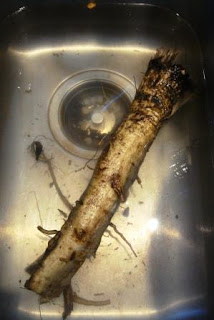

Burdock root: Burdock is native to most parts is seems, and there is certainly enough of it here. I am under the impression that burdock is considered by many 'a poor man's food', but food is food right? On the farm I have seen the root sliced up and cooked or sauted like other root vegetables and served with different sauces.


Honey: Living in an agricultural valley, what we cannot grow here tends to be easily available. Honey included. Orchard Blossom is a honey distributor up the road. If you bring your own container, you can get liquid honey at $6.50 CAD a kilogram - for those of you who are not avid honey buyers, that is a very good price. I have already filled four jars on behalf of some Vancouver friends of mine which they are anxiously awaiting to receive.

You may be wondering then what a typical day of meals would entail on the farm living on the low budget that we are living on. Right now, the farm is certainly still in early production mode, but we still have enough food to see us through our workday. Generally, each day we are currently eating salad, mixed greens, eggs, kefir, apples, and squash. For our grains, sugars and legumes we put an order into Discovery Organics to get bulk (and farm) prices.

I am eager to see what eating organically for the next six months does to my general health, energy levels and overall mood. Good things I hope!

Monday, May 16, 2011

Destruction - Wind Storm

Maybe it was a jinx of mine to talk so highly of the weather here, but the last two days have been a whirlwind, almost literally.

On Wednesday morning, the clouds had covered the valley. We took advantage of the cooler conditions to get into one of the greenhouses with the young greens to weed out the grass. It is usually best to weed when plants are young since you can see the unwanted matter more easily and the plants are relatively resilient to damage. In this case, it would also be a logistical nightmare to either wait until the greens had grown large enough to fill the rows to try and weed out the grass, and at the same time, we can’t exactly sell ‘greens and grass’ as a specialty food at the market - though I’m sure if you marketed it correctly people would claim it to be the new super food mix and eat it up like rabbits anyway.

Once it got too hot in the greenhouse, we headed over to the strawberry field. The irrigation system had been laid over the land we had weeded earlier in the week, so we set to planting the additional rows with strawberries. At Klippers we have sable strawberries that are ordered from Ontario. Though it seems that that is far for our little bundles of strawberries to travel, it is one of the closest organic sources in Canada, and an existing and good relationship between Klippers and the sender sealed the deal if you will. (Plus after living in Haida Gwaii and seeing how far their plants needed to travel to get to the island and at what cost, the mainland systems seem relatively affordable and well connected).


After lunch we transplanted tomatoes - 3900 of them. It was a hard day getting all of those tiny plants out, but it was done. We were sweaty, our faces were covered in dirt, and our hands had been wicked of their moisture from working in the dry earth.


Then it happened. That evening, around 8.00 pm, a windstorm picked-up with gusts that had not been seen around these parts for some time. As we looked out of our apprentice building, we could see the soil from our tomato field being ripped from the earth and sent to the heavens. Think dust bowl – a jet was streaming over our tiny plants and through the entire farm ripping everything in it’s path – at times we were in a complete dust whiteout. To give you a sense of how strong these winds were, there is a pile of 4’ by 5’ sheets of plywood that are outside our building. The wind was systematically lifting these sheets into the air which would then crash against our building in a loud thunder. The wind was strong.


Thursday was time to evaluate the damage.

The tomatoes, which I understand are usually traumatized from transplanting in the first place, were devastated. They looked so sad. Many of the plants had been blown under the plastic, so we had to go through and pull their limp and brittle bodies out into the sun again. Some of the plants had become so fragile that their leaves were crumbling to my touch. The whole while I was thinking that if these plants pull through, which I still want to believe many of them will, I will have a deeper appreciation for the resilience of vegetation. However, Annamarie thinks that we may have lost up to 50% of our plants because of the beating they took, and so we spent the afternoon in recovery mode.

We had to compensate for our lost plants. Luckily, when Annamarie seeds her plants, she uses a method called broadcast seeding. This is where you toss a bunch of seeds together into a small container to let them sprout. Once they have germinated (started to grow), you then go about pricking the little plants (separating the individual plants from the cluster of sprouted vegetation) into their own individual cells to get stronger. Annamarie joked that she almost always grossly over-seeds, but in times like this, she is glad that she does. We now have backups for our field plants in the event they don’t pull through.

We then had to do damage control on the strawberry field as well. All the mulch (the protective straw cover laid between the rows to retain the moisture and protect the field from weeds and erosion), had been blown away. Luckily much of it was scatter up against the fences surrounding the field, but we still had to peel it off where it had been wind blown and relay it between the strawberry rows.

That was all the recovery tasks we had for the day, but we also got to do a new job, one that I really enjoy – apricot thinning. Apricots are going to be one of the first fruit that we harvest. Right now the trees are covered in immature apricots. The sooner you thin the trees after the fruit have started to grow, the better harvest you will have, since the tree will have poured everything it has into growing the fruit you have left on the tree.

Some people have a challenge with thinning and pruning, because it seems like a waste to reduce your fruit production. With the apricots I can certainly understand since we would thin a branch covered in about 20 tiny apricots to maybe 4 or 5. However, if you do not do this, more damage will come to your harvest than if you ‘over thin’. First, your branch will be too heavy being weighed down with all the fruit and might break off the tree; second, your tree will grow many fruit that will be much smaller; and third, the clusters of apricots will grow into one another and thereby misshape and bruise each other. So, thinning is necessary.