Half way through my apprenticeship, I am in awe about how much I have learned, how much I have seen, how much I have experienced and I look forward for what is still to come. Since we are more than mid-way into the growing season, I thought it would be appropriate to share a visual documentation of 'where the farm is at'. Here is a collection of the current highlights of my job:

The apricots that we thinned earlier in the season have started to ripen. It turns out we have a few varieties of apricots growing at Klippers, so the bulk of the apricots are still not ready. Here you can see the different sizes and colours of those we are taking to market.

Next, we are lucky to have quite a few early harvest peaches at Klippers. This has allowed us to take peaches to market, which fly off the shelves so fast, for a couple of weeks now. Unfortunately, because peaches are so delicate, and worth so much, apprentices rarely harvest the peaches. That being said, we are lucky enough to get the seconds for breakfast, drying and smoothies!!

Every week we take multi-coloured bunches of chard to market. Usually we get about 30 - 40 bunches a week.
 We also bunch collards, which are a thick leaf green from the same family as cabbage. The leaves are great for wraps especially, but are also hardy enough to be cooked.
 Kale (Dad this is kale) is my favourite green. All of the chard, collards and kale are plants that you continue to harvest until it frosts - you take off the larger leaves each week and then by the next week the plant has grown big enough to do the same thing again.
 Garlic! After harvesting tons of garlic scapes, which caused my hands to peel horribly because of the acid in the plant sap, the bulbs thickened up nicely and we have now started to harvest them for storage. Currently we are taking about 420 heads to market on the weekend, which sell for $3.00 each or 4 for $10.00. We will continue to take fresh garlic for many weeks, but that which is in the ground needs to come out. For this reason, we are drying the garlic by hanging bunches in our sheds or laying them out on tables. The important thing is to avoid the sun and to keep the air circulating so that the bulbs dont rot. It has taken us about 18 hrs to do 6 rows. We have 12 more to go. Garlic is a big job.
 After the turnip root maggot, the only other problem we have encountered, besides the cold weather which has put the growing season behind, is aphids. Aphids seem to love our salad greens in the green houses and all the collards (cabbage, broccoli, cauliflower, collards, kale, kohlrabi). If you can see the grey powder looking residue on the cabbage above, it is in fact all aphids! The problem is the bugs are so small that it really doesn't warrant searching through the leaves to clean them, so we are discarding a lot of plant material to the chickens which could normally be used for human consumption. But I understand you always need to account for loss.
 Beans are now being harvested every Monday and Thursday. It is amazing how fast a vegetable can ripen. Every time we do the bean harvest we have buckets of beans, where three days earlier, those beans were not at all ready. We have yellow, purple, green and a purple/yellow bean growing. We didn't have very good germination with the beans, so two weeks ago we filled in all the empty spots with more beans. However, the maturation time for the plant is about 6-7 weeks, which puts us in to September. For this reason, we won't be planting any more this year.
 This is a Hungarian Hot Pepper. I have not yet tried one, but understand it is very spicy. It is the first of our peppers to be ripe. If ever you need to curb the spice burning in your mouth, and don't drink or have milk, you can use a parsley concoction.
 The basil is doing very well given their rough start. We are still working on making the plants big and bushy, which means we harvest the leaves and sell them by the pound ($20.00/lb) at market. Above you can see one of the varieties of basil we grow, lettuce leaf basil, so named for it's very large leaves. To bush up the plants, we have to pinch off the heads from the plan so that where there was one head, now two will grow.

Organic carrots are one of my favourite foods. If ever you need to do a taste comparison between organic and non-organic, use carrots. You will be impressed. We have purple, red, rainbow and orange carrots being harvested right now. Some are from a bind weed infested field, which is a bit of a pain, but the carrots are still tasting delicious. Once we pitch fork them out and bunch them, we then need to pressure wash the dirt off. See the brilliant difference in colour!
 I am allergic to beets, to which everyone says they are sorry for me. I can understand the appeal of beets given their many uses (soup, salad, roasted, dried) and their fabulous colours. On our farm we have purple, red, white and gold beets. It is really fun to pull the big ones and also to jet the dirt off to reveal their brilliant colours. That being said, we have SO many beets going to market, that the beet harvest is definitely an event. Still, we can't seem to harvest enough for market.
 We put in a second herb garden about a month ago. I am really not very good at using fresh herbs because they are normally so expensive to buy in the store and then it is so difficult to finish them before they go bad. For this reason, I will just say that finding ways to incorporate more fresh herbs into my diet is a current personal goal. Especially because consumers tend to be in the same boat as I and do ask for ways to use the herbs. All I know for sure is that our mint is outstanding in mojitos.

This is Kirsten harvesting beets in the bind weed field. As you can see, the field looks less cultivated and more wild. We stopped weeding this field, once the crops had enough of a presence that they could fend for themselves against the weeds. When 'harvesting' in this field I feel more like I am foraging than harvesting though because you have to dig through the weeds to find your crop.
 Kirsten pressure washing some of our purple beets. I really enjoy the pressure washing job.
That's the it folks. Enjoy your organic produce. We've worked hard to prepare it for you.
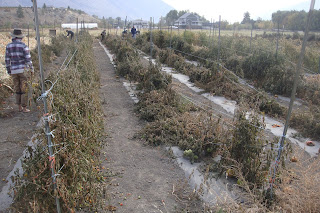 Tomatoes! Death becomes you. The tomatoes are dead. The frost earlier this week did them in, and we are happy. A couple of people here still tried to salvage a few last tomatoes to extend the tomatoe sandwhich addictions they have developed over the last few weeks. And others yet were trying to nab a few for seed saving purposes. But for the most part, we are done with them. (Side note - to save tomato seeds you crush the seeds out of the flesh of the tomato, cover these vegetable innards and let them ferment which deactivates the compounds that would allow the seeds to sprout. So when you actually collect the seeds, you are getting them out of a goopy, foul smelling, fermented mess you have let sit for weeks.)


