


Finally a free moment to catch up. Today is the first 'free day' I have allowed myself in over three weeks and boy is it nice to wake up without the sound of your alarm chiming in your ear...even if it still is at 6.00 am.
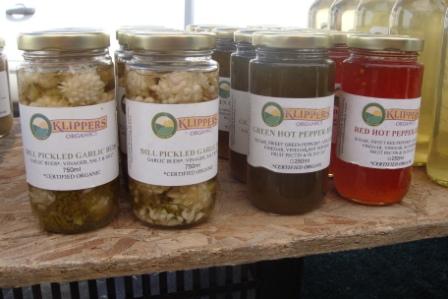
Last weekend I had the pleasure of attending my first market weekend in Vancouver. At Klippers Organics, they retail all their goods directly through farmers' markets. The benefit of selling directly to the customers, is that you fully benefit the retail prices, you have the opportunity to hear first hand what your customers are looking for and to meet special requests, and you are also able to answer all questions about the production of your products - in other words, the food is transparent.
However, on the same side, Klippers needs to make the four hour trek twice a week to Vancouver in order to service the four markets to which they sell - Main Street (Wednesdays), West End & Trout Lake (Saturdays), and Kitsilano (Sundays). On Friday, after a full day of harvesting, we packed up the truck and trailor once the heat had started to subside and started the drive to the city. Given I was staying at a friend's in the city, and Kevin and Annamarie stay in Chilliwack, it was a long Friday to say the least.
Saturday morning, again up at the break of dawn, we started setting up our goods at 7.00 am at Trout Lake. In the city, Klippers has what I call their 'urban workers' or otherwise known as their market volunteers. These lot help staff the markets in exchange for some delicious organic produce. At Trout Lake I was introduced to long-time helpers Alex (the almost 7' giant you will see at market with us), Marley (the apple chip lady) and Natasha (a former apprentice and the cashier girl).
The team was fun and certainly knowledgeable about the routine. Right away we started unloading the truck and setting out the food for sale and creating our temporary store in Trout Lake park. I was charged with organizing the 50 (unsure of exact number) or so varieties of tomato plants we had for sale. (I have since asked Annamarie for the list of all our tomato varieties so that come harvest time I will be able to better speak to the tomatoes we have for sale. There are a lot to memorize.)
One of the important aspects for me this first weekend, other than to see the setup and the general sale process, was to get better aquainted with the prices of our products. We sell bunches (about 8 stalks) of kale and collards for $2.50, salad mix was $5.00 a bag, kohlrabi was also $5.00, $6.00 for a dozen eggs and apples from last fall were selling for $1.99/lb. You can certainly see that people are willing to pay well for good food and that making the trip to Vancouver does guarantee competative retail prices for the farmers.
That being said, what we can sell all depends on what we could harvest. The saying, the early bird gets the worm, is certainly applicable when it comes to market. Very quickly we sold out of zucchini, cucumber, tarragon, kohlrabi, kale, and chard. When it is so early in an already inconsisten meteoroligical season, there are only so many pieces of these items to go around.
I focused my attention on keeping our shelves stoked, answering peoples questions (which I will get back to) and observing the shoppers. I would describe the Trout Lake crowd as a combination of food enthusiasts, organic activists, well-to-do urbanites and concerned moms. I would like to say that a good number of hte customers going by had their babies or toddlers with them, as they searched for appropriate and healthy food to feed their children.
By attending more markets, you will also be able to tell how 'current events' and the weather affect the turnout at markets. You can't seel to people if they don't show up in the 5 hour window of buying time available. On this particular Saturday, we were selling fast because everyone was out in anticipation of the Canucks second Stanley Cup playoff game at Rogers Arena as well as the fact that is was sunny for the first time in a while. This means sales!
One of the most enjoyable aspects of attending market, was talking to people and answering their questions. Being in the field all week, I was the expert about what was going on at the farm and when certain products could be expected from us. HOWEVER, it also made me realize how uninformed many people are about food, even those who shop at farmers' markets. I had one lady come up and ask when apple season was in the Okanagan as she was looking at our not-perfectly-crispy apples. Now I learned that apples are a fall fruit when I was about 4 years old at school. I don't know how this information has overlooked this woman or how she has not been able to observe the arrival of 'local' apples in stores every fall, but this experience sure did make my eyes open to the level of ignorance that exists around food.
The week prior to going to the market, I was on the fence about my future as a farmer. I am loving my experience here, but I believe being in the Similkameen 'bubble' alloud me to forget how important the work we are doing here is for society. Attending the markets reinvigorated my enthusiasm for farming and organic food. I was able to see again the people with whom I share their food values and those with whom I do not. I was also able to see the appreciation from buyers that someone is doing the hard work required to provide them with safe and nutritious food.
The combination of wanting to be able to have all the answers for our consumers, to provide the best and most diverse crop, and to provide the best shopping experience has renewed my enthusiasm for farming and allowed me to work harder at the tasks we are assigned. I can't wait to be back at market too, and share my knowledge first hand.


