Sunday, October 30, 2011

Greenhouse Cleanup


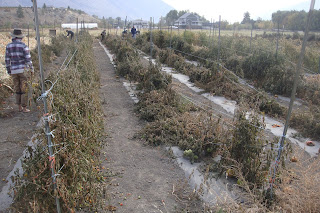
I can't remember exactly when we abandoned the greenhouses, but it must have been sometime in August. Three months later, the greenhouses have become jungles. Plants were completely overgrown trying to fight for space; the vegetables that remained were of huge proportions, mouse-bitten or rotting; the density and moisture of the plants caused some of the plants to rot and others to shoot out roots six feet in the air. The sight of the greenhouse was particularly amazing because there was so much going on in this unique growing environment.

When we cleaned up, we tried to rip everything out as fast as possible. Some people tried to salvage the monster zucchini or cucumbers, other were trying to protect their faces from the mold cloud that went into the air when we started to disturb the plants. We are lucky that the green houses are beside the chicken area, because we could remove all the plant matter directly into their fields for them to eat. Chickens love cucumbers apparently!

Apples


The biggest late crop we have are our apples. They are able to withstand a freeze of up to -6 degrees Celsius, and cold weather actually helps sweeten them up. Luckily at our farm, one of the girls worked as an apple picker for several years before being taken on at Klippers Organics. For this reason, she has pretty much been put in charge of taking off the fruit because she is 1) fastest and 2) least likely to bruise the fruit. Nevertheless, we do have so many apples, that we all did get a chance to take part in the fun.

I have learned that you need to flip the apples off the tree keeping the stem on the apple. If the stem is removed, the apple dries out much more quickly. Also, when we are clearing the trees - that means removing all the fruit at once - we wear harnessed apple picking bags that strap across our back and have notches to hold up the bag when picking at a variety of heights, depending on how much apple weight you are strong enough to carry, and then release the bag into the big tractor-moved bins for storage. Like most of the fresh products here, bruising is a concern, as bruises reduce the lifespan of the apple. So when you are picking, we've been taught to get into the habit of placing the apples in the bag with the back of your hands to the bottom of the bag. This prevents you from dropping the apples into the bag, especially when you are trying to go fast, and causing them to bruise by hitting one another.

Another trick I learned from the apple-pro is to pick as much weight as you can at the top of a tree when you have to be standing on a ladder, them climb down and fill you bag to the brim with apples from the bottom of the tree when you have your two feet on solid ground again. Personally, ladders freak me out, especially when you are carying a sack of heavy apples strapped to your front, so I tried my best to stay on the ground. Being tall was very beneficial in this quest.


When we are not clearing the trees, we take the time to spot-pick apples that are ripe. Though this is more labour intensive process, in terms of sales, it gives you the advantage of being first at the market with a certain crop or variety of crop. What this means in turn, is that the consumer gets used to bying that product from you, because you had it first. So it can be argued that the time investment is worth it. Spot picking is much more challenging especially when you don't know the varieties very well. You don't pick just on size, but on colour too. So for certain apples, such as the Muzu, they were picked when they had a yellow to pink blush on them.

If you pick an apple too early, the sugars haven't fully developed and the fruit flesh is still quite starchy. No one on the farm is particularly an expert at knowing the starch level in any given season, and for growers that sell to the packing house, Cawston Cold Storage, they receive free testing of their fruit sugar content so that they know exactly when to pick for the packing house. Then we call the neighbours and find out what they were told :) Convenient.

As far as I know we have harvested (in this order) Shamrocks, Cox Pippen, MacIntosh, Gala, Spartan, Golden Delicious, Red Delicious, Muzu, Granny Smith, Fuji and still to come off are our Pink Ladies.

My favourite apples have been the Cox Pippen, Muzu and Fuji. I know I like Pink Ladies, so I will be eager to try them too! We don't have any Winter Banana apples on the property, but I have learned this year that I like them a lot too.

Apples need to be kept in the cooler in order to have them keep over the winter. However, because we have so many apples, 1) there is no way that we would be able to sell them all before they start to go and 2) we don't have the space to store them all! So we process the fruit.


With the excess apples we make both apple juice and dried apple chips. For both we have external companies that do the processing on behalf of the farm, so we need to get the apples sorted for juicing or drying. A juicing apples is one that is small, mis-shaped or severely damaged. A drying apple is one that is large to excessively large because they will then be a decent size once all the water is dehydrated from them.

For home processing we have collected many of the apples that dropped to the ground before we could get to them or while we were picking. There are also the bird pecked fruit. Apparently the birds like apples as much as we do, and they have seriously done some damage on some of the fruit.

Wednesday, October 26, 2011

Happy Birthday!


This past Friday, our last harvest day, was farmer Annamarie's birthday. Appropriately, I made her wear a 'Happy Birthday' tiara all day long while working in the fields, and we also made her a delicious surprise (Klippers' organic) carrot cake with cream cheese icing.


Annamarie started her birthday slicing onions to dehydrate for market sale - not every girls dream day. But for this hardworking birthday girl there was no day off, so at least we made it as fun as possible!

Monday, October 24, 2011

Chicken Coop Clean-Up


Today we cleaned this chicken coop. This is a job that happens twice a year and is accordingly very disgusting. The actual shoveling of shit does not bother me, but the smell that is released from layers and layers of crap being disturbed. The odour is definitely very ripe and infiltrates the nostrils despite our wearing of masks. The only good news is it won't need to be done for another six months - and that the chickens now have a clean home once again.

Saturday, October 22, 2011

Tomatoes, Celery, Corn, Basil and Hot Peppers

Tomatoes! Death becomes you. The tomatoes are dead. The frost earlier this week did them in, and we are happy. A couple of people here still tried to salvage a few last tomatoes to extend the tomatoe sandwhich addictions they have developed over the last few weeks. And others yet were trying to nab a few for seed saving purposes. But for the most part, we are done with them. (Side note - to save tomato seeds you crush the seeds out of the flesh of the tomato, cover these vegetable innards and let them ferment which deactivates the compounds that would allow the seeds to sprout. So when you actually collect the seeds, you are getting them out of a goopy, foul smelling, fermented mess you have let sit for weeks.)

Now we are undoing all the work in the tomato field we spent seeks putting together, namely cutting down all the supporting strings, then we'll remove the metal poles and the plants and last the plastic mulch and irrigation system. This should all be done by next week.


On the only two crops that remain in the field that was assigned to me is celery and celeriac. This weekend was the last summer market in Vancouver, so we harvested most of the remaining celery to send off for sale. I am unsure if they will keep the rest for winter markets.


Back behing the tomato field was planted two rows of pop corn. After the frost, this too was ready to come off. We tore off the cobs, peeled them back right away and will let them cure for a few months in a dry and well ventilated location. Once they are dry you can pop the corn right off the cob in the microwave or if you would like to pan pop just peel back the kernels. The cobs sell for $1.50 each.

By the time the frost was strong enough to kill the other crops, it had devastated the basil. When it froze, the basil turned black-brown and looked like death. I didn't make any pesto or really use the basil too much this summer, though I thought about it, but working in the basil field was always a favourite. Some would say it makes a person smell delicious!

Last but not least are the hot peppers. I took a special interest in the hot peppers in recent weeks, a crop which sells for $15.00/lb, and got to know each of our varieties quite well. When dealing with hot peppers, a popular question is how hot are the peppers really? Well it turns out that there is a grading system for 'hotness' called the Scoville Scale and it is measure in Scoville heat units (SHU). For example, a sweet bell pepper has 0 SHU while a jalapeno has anywhere from 2,500- 8,000 SHU. On our farm we grow a wide variety of hot peppers, and our hottest is the habanero which is around 300,000 SHU. That's right, it is often 100 times hotter than a jalapeno.

The peppers we grow are pablano, padrone, habanero, jalapeno, hungarian hot, serrano, yellow cayenne, cherry bomb, joe's long cayenne, purple cayenne and thai dragon chile. I dehydrated a of these varieties for later use and also pickled a few varieties. Take a look!


Habanero pepper basket.

Thursday, October 20, 2011

Adventure: Leavenworth, WA


Since 'cultivating adventure' has been a primary focus of my lifestyle change, I am pleased to report that I have been able to successfully incorporate adventures into my weekly routine. This summer the adventure focus has mostly involved outdoor rock climbing.

Climbing is addictive. It requires physical strength and flexibility, mental stamina (read stubborness), problem solving, technical skill and a certain level of bravery. The wall is what challenges you. Sometimes you win and other times the wall does; but with persistence, you usually are able to overcome whatever problems are presented to you on a route.

I started climbing outdoors in June of this year. I luckily was connected with a fabulous group of young professionals who spend all their free time climbing, talking about climbing or dreaming about climbing - it was a good fit. Their level was much further advanced than mine, so I quickly had to improve to be a respectable participant in our weekly hangouts. Needless to say, my stubborness, has paid off.

Two weeks ago I went on a climing trip to Leavenworth, WA with some friends from the area. The climbs were mainly traditional, which means they required gear, and the climing was definitely graded much differently than where we normally climb. It made for some interesting ascents as we never knew what to expect when starting a route. (Including not having an anchor at the top of one route and having to then figure out how to get down safely then rescue the gear thereafter!)

The two most memorable moments of the trip are this. First, we arrived late into town and headed directly for the campsite. It turns out that Leavenworth is an American-style tourist destination that has taken the Bavarian theme to a whole new level. For this reason, the Leavenworth population had exploded from 2,000 to 10,00 for Oktoberfest celebrations the weekend we were visiting to climb. This meant, around midnight, there were no free campsites. In the end, we ended up crashing someone else's enormous campsite and hoped for the best - that is that they wouldn't throw a fit that we were there. I was informed by doing this, and generally being a climber, meant that I was now a 'dirtbag climber'. I was not glad to hear this information, nor did I want to accept that I was a dirtbag. Unfortunately, my new friends insisted that this is the case, that it is not so bag to be a dirtbag, and that I might as well just accept it. In the end, if camping on a crystal clear river, waking up to snow-covered mountains, meeting many interesting local outdoor/climbing enthusiasts, ascenting challenging and scenic mountaintops and cliffs, and laughing with friends at the end of the day around a campfire means I am a dirtbag climber, I will accept ownership of the title.

The second awesome thing about the trip was lederhosen.


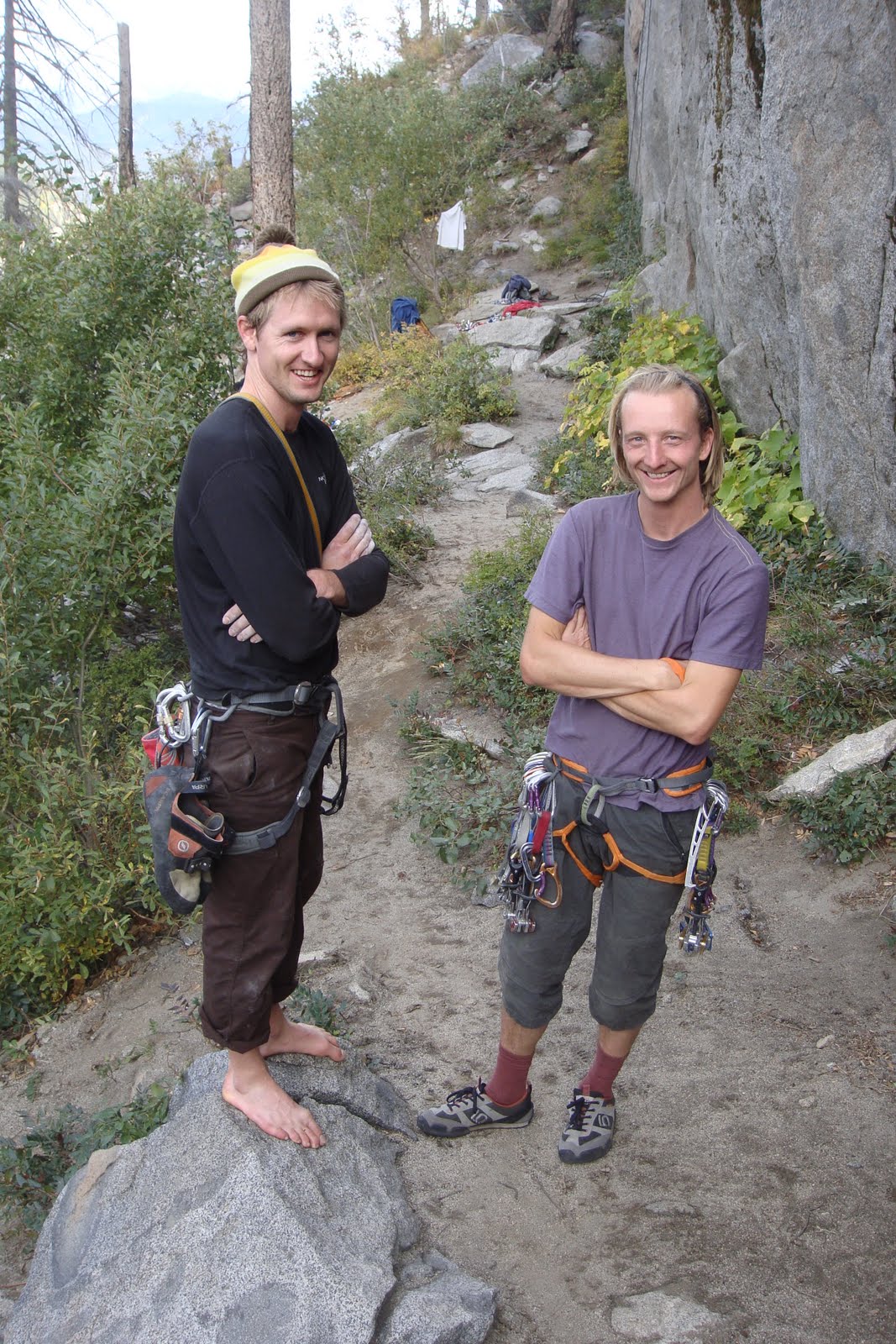
Fellow dirtbags, Andrew and Flo.


Our crashed campsite.


Shauna and Catalina with a local lederhosen enthusiast.

$30,000 for the Organic Farming Institute of British Columbia

This summer I wanted to make sure that I was involved in the broader organic farming community in BC. To do this, I chose to support the Organic Farming Institute of British Columbia by becoming their temporary-volunteer administrator. My first task was to complete a grant application to the Southern Interior Beetle Action Coalition (SIBAC) for the sum of $30,000 which we will use to develop and implement a new organic ground crop course for potential organic farmers in the province and hopefully provide an alternate economy for those areas hardest hit by the pine beetle. Here are the results:

ORGANIC FARMING INSTITUTE RECEIVES $30,000

At the September 19th Board Meeting, the Southern Interior Beetle Action Coalition (SIBAC) Directors voted in favour of supporting an application from the Organic Farming Institute of British Columbia (OFIBC) for $30,000.00 to develop an online organic field crop production course. SIBAC Director Randy McLean (Regional District of Okanagan Similkameen) said, “The SIBAC Board viewed this application as an opportunity to support a project that will be beneficial to not only the SimilkameenValley, but any region in the province with suitable land for growing ground crops.” The Organic Farming Institute of British Columbia is a non-profit organization that aims to increase the economic viability of regions throughout British Columbia through organic farming. The SIBAC funding will help to develop a new online educational program to educate prospective farmers in organic field crop production. Kevin Klippenstein, OFIBC Chairman said, “We look forward to being able to provide people in BC with the opportunity to broaden their knowledge, learn ways to supplement their livelihoods and most importantly grow healthy organic food. Thanks to the support of SIBAC, the resources that will allow these goals to become a reality can materialize." SIBAC is one of three Beetle Action Coalitions in BC’s Interior created in 2005-2006 to develop and implement mitigation plans in order to help affected communities endure the impacts of the mountain pine beetle epidemic. The funding is intended to support projects approved by the Beetle Action Coalitions that will create business partnerships, diversify local and regional economies, find innovative and value-added uses for forest resources and explore new industries to assist rural interior communities through this transition.

source: http://www.thenewsleader.info/october-2011.html

(Tbe words are pretty much all mine :) )