Monday, April 25, 2011

Tlell Bay Farm

The plants are growing. After three weeks of tending to the garden in all sorts of weather, the days have become noticeably warmer and sunnier. The garden has certainly responded as expected and the greenery that we have in the ground is shooting up.

Today we finally have finished prepping the garden beds for the summer with a little help from the most dedicated worked I have ever met. His name is Sylvan and he is four-years-old. Sylvan recently arrived from Ontario with his mother, Leanne, and they are living on the property in between Ross' bus and Sabrina's cabin. Sylvan is probably my favourite four-year-old I have ever met. His energy is very relaxed, he is extremely social but not hyperactive, he always wants to work and he talks very matter-of-factly. For instance, while we were gardening, he asked me what I had in my ears. I explained that they were earphones and that I listen to music from them. He asked for a listen, so I gave him one of the ear-buds. At the time I was listening to Audioslave, which isn't exactly four-year-old music in my mind, but I asked him if he liked the music. He said, "Yes. I love it." He makes me very happy.

So throughout the day Sylvan was my sidekick. He turned the soil with tools that are far bigger than he, he pulled the weeds out and shook off the soil as directed, he filled our bucket with grasses and went to feed the chickens religiously, and he even came to visit the goats, though I think he was a little bit afraid since he asked to hold my hand.

In the kitchen later that day, Sylvan also asked me if he could help me cook dinner, which I thought was very kind of him. So I had him bring over a chair so he could reach the cooking pots and pans. He managed to cook our noodles, to bread my buttered casserole dish, and when I had ran out of jobs for him, he kindly crushed all the eggshells under the sink for the garden. And then while listening to Dolly Parton, we danced.


Sylvan is an absolute pleasure and I already know I am going to miss him when we leave in a few days. Bonnie thinks we have a funny relationship - she knows I like him because he is the a productive child with a positive attitude. Sylvan always wants to be involved, and I let him, so we get along very well.

The dynamic on the farm is fairly complex because there are so many people who live here and contribute to the running in different ways. First there is farmer Elizabeth. Elizabeth has lived on the island for something like 40 years. She has a deep love of horses and Africa, has had a very successful career in public education and has had some fantastic life experiences. When she was younger, for example, she was part owner of a gold mine in the Yukon and for two summers cleaned gold and cooked for the miners. Elizabeth is the centre of the activities on Tlell Bay Farm. She is knowledgeable and resourceful about the happenings and people on the island, and also very involved in the community. Unfortunately, her health prevents her from being able to do much of the manual components on the farm, which is where the support team come in including us WWOOFers. Nonetheless, she milks the goats twice daily with much skill, prepares the eggs for sale, keeps the endless supply of dishes clean and cooks some pretty good meals too! Her primary focus in the house though is her dog Kazy who never leaves Elizabeth's side.


Elizabeth's first helper is husband Bill. Bill is originally from the States, but has lived here for some time as well. Bill has a number of health problems (and still hasn't quit smoking), and has a unique diet consisting primarily of Corn Pops, white bread and coffee. I will always remember Bill for being wrapped around Sasha, Kiki and Didi's little paws - these are Bill's cats. Didi is the biggest princess I have ever met and never leaves Bill's side. She calls him for cookies, for milk, for food from the table and to be picked up. You will often hear Bill say, "Didi I'd like to help you out, I really would, but I just can't give you any milk right now." The cats are very affectionate to Bill in return for his devotion to them. As evidence I have discovered Didi licking Bill's arm as he reads his paper to show she cares.

Brian lives in the basement apartment of the house. He came to Haida Gwaii five years ago to WWOOF for Elizabeth and decided to stay. Brian is originally from Toronto, but the city life burned him out. Now he makes cheese for sale at the Crowsnest where he also works on weekend, bakes delicious sugar free goodies (because he is diabetic), and helps keep Elizabeth and Bill's de-cluttered and clean. Brian's apartment is extremely organized and tidy. Brian too has a couple of cats. Puddin' and Pie have as much character as any of the other animals on this farm. Puddin' is an old rescue cat with fairly advanced arthritis in her hips. The arthritis causes her to stomp around the house at a slow but deliberate way. She spends most of her days sleeping on the chair and seems particularly frail and delicate. However, she has the most gorgeous eyes with the most life I have ever witnessed in a cat. Pie on the other hand is a bully. He is cross-eyed and fat too. If there is activity going on anywhere on the farm, you can guarantee that Pie will be there without delay. Pie, however obnoxious though, is Bonnie's favourite cat.


Ross lives in a blue school bus. As I understand it, Ross was living on the street for a while when he was a teenager, but ended up being taken in by Elizabeth and Bill. Ross reminds me of Snoopy some days and the pied piper on others. Ross' character is certainly mysterious but a little bit silly at the same time. Whenever you see Ross he will be wearing a sweater and his distinctive red hat. Some days he will appear playing his flute. We are greeted by Ross every morning when he arrives at the house for his coffee where we often hear him talk about his failed marriage with his still wife who lives in Vancouver. Today, Ross has taken Bonnie to town to go for some Belgian waffles, and tomorrow he starts a new job. Ross is a plumber by trade.

Ross' bus, despite all expectation, is quite comfortable.

Behind the bus you will arrive at Sabrina's cabin. Sabrina is Elizabeth and Bill's daughter. An ex-boyfriend of hers is the one who bought the bus. When he left, Sabrina moved in for a two year period. Then, when her German shepherd puppy started to grow, it got a little bit cramped, so she bought five acres of her mother's land and moved into the house. While here, we have also helped Sabrina with a few projects including setting up a greenhouse and levelling and weeding her garden area. Sabrina and Jack show up twice a day to pick up Elizabeth and Kazy for a walk around the property. During the day time, Sabrina works as a massage therapist. She has turned one of the other cabin's on the property into her clinic so she doesn't have to travel very far for work.

Last we have Leanne. Sylvan's mother has recently returned to the Tlell Bay Farm. She originally came to the island when she was 25 and pregnant with Sylvan to find an accepting and nurturing community. After being convinced to return to Ontario by her parents - they drove out here to come get her - she realized how much she missed the energy of the island. She has returned, though is uncertain of her decision and still trying to figure out where home is going to be for her and her son. Her ambition is to record a number of albums she has within her and to share her passion for music with others.

To round out the day I spent the afternoon tilling and planting a potato field with Dave and Matthew, a couple of locals that Elizabeth has rented part of her land to for the summer. It was hard work, but I think we planted at least four or five sacs of potatoes by the end of the day. I learned that I had to pack down the soil over the potatoes when I covered them in order for the soil to maintain a proper moisture level. However, when I asked why it was I had to pack down the soil, the initial response I received alluded to the fact that it was purely for superstition's sake. It is curious that so many component tasks we must do to effectively grow crops become routine without really knowing the reason behind them. I was glad that I received an answer in the end.

We have four more days on Tlell Bay Farm. I believe I will need to start packing again very soon.

Sunday, April 24, 2011

Easter Egg Thievery

So here is an Easter egg story. This morning I spent 3 hours dying, painting and colouring 24 hard boiled Easter eggs. I had pink eggs, green eggs, blue eggs and yellow eggs. There were easter bunnies on eggs, flowers on eggs, humpty dumpty eggs and even tie dye retro eggs. They were fun, they were colourful and they were the perfect size for children to find. At least so we thought.

We waited until 4.00 pm to go out into the forest to hide the eggs since the children were arriving at 5.00 pm for the hunt. In hand we had the 24 finely crafted hard boiled eggs as well as six Kinder Surprise eggs. They looked great in the forest. Bonnie and I hid eggs under tree roots, in tree branches, and in the moss. I made special nests for the Kinder Surprise eggs, one for each child to find. I was so pleased with our preparations, I was dissapointed I didn't have a camera to capture the moment. But, I figured, I could get a picture of the eggs, the forest and happy kids once they had found the eggs! We were excited for that moment to arrive - unfortunately, it never did.

At 5.15 pm I was duly informed that no eggs could be found. I was in disbelief. I didn't think I had hidden the eggs too difficultly, though it was a possibility since I have been well trained in the art of Easter egg hiding and hunting. (When I was 10 years old I wond third prize in an Easter Egg hunt at Mont Tremblant ski resort. I was a competitive child.) However since the hockey game was on, Bonnie was kind enough to go out to help the children at least find the eggs she had hidden. No luck. All that could be found were the Kinder Surprise nests sans eggs. So I got dressed up to confirm the reports and show these kids where their search had go arye.

But....NO EGGS WERE FOUND! All my hiding places had been robbed without one single sign of a broken egg shell or any other kind of evidence. It certainly appeared that someone had stolen all the eggs and with it all of my Easter cheer.

The locals have tried to convince me that an animal must have collected the eggs in our absence, however I cannot imagine a busy body squirrel, raccoon or raven going around the forest assembling 30 full-sized, full-weight eggs to store in a hidden stash. I am in disbelief. I am more likely to believe that someone came along, found the stash and decided to help themselves.

But, what can you do? At least the children had a great time looking for the eggs that they would never find.

On top of it all, the Canucks lost their third game in a row tonight.

Happy Easter I guess....

Thursday, April 21, 2011

Wwoof!

I have yet to explain how it is that I ended up at Tlell Bay Farm in Tlell, British Columbia. Bonnie and I are members of an organization known as WWOOF Canada - Worldwide Opportunities on Organic Farms (in Canada). The organization was originally started in England under the name Working Weekends on Organic Farms to provide Londoners the opportunity to escape to the country side with free accomodation and board in exchange for a few hours of work on the farms they would visit. As the movement progressed to allow volunteers to stay for more than weekends, the organization became known as Willing Workers On Organic Farms. Now the movement is a global one. Every country runs its own organization listing and membership database. Essentially, hosts (the farmers) need to subscribe and pay a membership fee to their national organization in order to have their information listed. Wwoofers (volunteers) then have to subscribe and pay their fee to have access to this information.

In Canada, the opportunities are plenty. You can search for farms based on a number of criteria including the location where you would like to live or the type of farming you would like to undertake. Usually the hosts are quite detailed in the accomodation they have to offer, the conditions in which you will be working and the type of work commitment they expect from you in exchange for your work. They accepted norm is 20 - 25 hrs of work a week, however some hosts do require you work 8-10 hrs per day. Ideally, you need to be able to express what you are looking for and your expectations of a certain host in an adequate fashion, as well as request the same of them so that your WWOOFing experience is not a poor one.(For instance, is cell phone service or internet an important consideration for you? Is your host able to accomodate a vegetarian or vegan diet? Is smoking allowed onsite?)

Though the WWOOF movement is a global one, 'WWOOFing' is still not a term that is immediately recognized in most circles. However, on Haida Gwaii, I have learned that it is a common term for the locals - so common that when Bonnie and I have met new people on the island, we are either introduced as WWOOFers by our hosts or people will ask us if we are here as WWOOFers. Apparently we do not give the impression yet of being locals.

I found Tlell Bay Farm in November 2010 on the WWOOF Canada website. I was looking for a place that could take both Bonnie and I in April and that was not too isolated since we wanted to have the opportunity to explore Haida Gwaii. There are many many farms on Haida Gwaii that accept WWOOFers, and we were actually turned away by a few to which we sent emails of interest. I did a little dance when I got the news to my Blackberry that we would be welcomed in Tlell come April.

I do not know why we were turned away from the other farms, but I do get the impression thtt certain hosts are very popular because of their location or what they have to offer in terms of learning or recreation. Nevertheless, I have also learned that the biggest difficulty with volunteers is the fact that they don't show up! Farmer Elizabeth has even said that she only really believes someone is coming once they have landed at the airport or ferry terminal on Haida Gwaii.

I can see how changing plans on a host can be difficult, however I also empathize with individuals who just don't know where they are going to be in 1-, 2- or 3-months time. For instance, currently I am talking with a woman in Tuscany who owns an olive farm to see if I could work for her during the harvest season starting in November. Olive oil is probably my all time favourite food product, so much so that my parents and good friends are constantly bringing me bottles of olive oil from their travels around the world. It is a dream of mine to be a part of the harvest and participate in the oil production. Though the Tuscan farm is happy to take me, I cannot at this time say that I am 100% committed because I am unsure how my life will have developed in the next six months. Maybe I will have fallen in love with life in Cawston, BC, and want to stay there for another year? Or maybe I will be very ready to get away from the life I had lead for the last six months and go abroad? Both sound like realistic options at this time.

One of our neighbouring farms currently has a WWOOFer from Germany. Stef is 25 and studied agriculture at university. While Bonnie and I know that we are leaving on May 2, 2011 to our next destination, if you ask Stef, she doesn't know when she is leaving or where she is going next. It is great to be able to find hosts that have the flexibility to keep you for an indefinite amount of time, but this also means that she will be limited in her next destination because she will only be able to provide a limited amount of notice to her arrival. There are pros and cons to each approach, but as a planner at heart, I would recommend that you look for the best farms that meet the most of your criteria and commit to these individuals well in advance (4 - 6 months if possible).

So what has my life as a WWOOFer been like so far? Honestly great! I feel like I am on a vacation for the most part. I am able to wake up each day, look at the weather, see what the other people in our house are up to for the day, and evaluate how I can most effectively use my time - is it best to go for a hike first or maybe garden for a few hours and then take off? Farmer Elizabeth gave Bonnie and I an orientation on day one and then typed up a list of projects that she would like us to complete during our stay. While here I have met a few hosts who disagree with this approach and believe that it is better to be working with your volunteers in order to show that 'you are in the trenches too', but I disagree with this belief. With a list, Bonnie and I are able to manage our time, choose our projects in the order we desire and we are not being micro-managed which could easily make the work we are doing lose its element of fun very quickly. Knowing the number of hours we need to contribute to the farm a week, we are also able to get away for a few days knowing that we can just work harder in advance or after our getaway. That being said, I have heard of some hosts that do treat their WWOOFers a little bit like 'free labor' in its purest sense and have very unusual requests of their volunteers. WWOOFing to me involves a certain amount of agricultural activity. If you are being asked to act as a cleaning person for the majority of your time, you are not being given the opportunity to be a WWOOFer.

There are already a number of experiences I have had as a WWOOFer that are new to me. First, I have learned about a number of new gardening tools and their uses, about composting, fertilizing and mulching, about how to set up a green house, about different seeding methods, and about chickens and their care. Plus it is so nice to be sitting outside under the sun, listening to some good music and working with your hands while you imagine what you would still be doing if you had not quit your job. Really it is a fantastic feeling.

If you are interested in WWOOFing in Canada, start your search at www.wwoof.ca. It is worth spending getting a membership to browse the opportunities and start making some connections. At the very least, you will be supporting a great movement. WWOOF!

Gwaii Haanas National Park

I feel alive. When coming to Haida Gwaii, Bonnie and I were committed to doing everything possible to get to Gwaii Haanas National Park. It was our indulgence for ourselves but well worth the money spent. The park is world renowned as well as a UNESCO World Heritage site, and for the most part the landscape is out-of-this-world!

It turns out that the park is not even open in April because it is still so early in the tourist season, nevertheless, we were able to find a local outfitter that would take us if we had at least four participants for a two day trip. Bonnie and I started canvassing the new people we met and before we knew it we had two young German travelors eager to join us on our exploration of Gwaii Haanas. One of the benefits of visiting the park so early in the season is that we did not have to pay the $20.00 per day fee to be in the park, nor did we have to worry about bumping into other tourists at some of the more popular sites.


So, we started our trip getting all dressed up in our rain proof Helly Hanson gear that we would be wearing for the next two days. Once we had waddled over to the zodiac, we were ready to go.


There were a number of highlights from the time that followed.


First we went to visit an old logging village that was active from around 1920 to 1960. This logging site was unique because it was the only one that used trains on the island to move the logs directly onto the ships. It is hard to imagine that the decaying wood that now supports the remains of what use to be an active loading dock could even hold a train and all the supporting equipment that went along with such a production. The sitka spruce that were harvested from the area were used during the second world war to build mosquito planes. A design was developed for the wood planes when metal became too scare or pricy due to its other uses, and the benefit of a wood plane was that it wasn't trackable on radar.


As we ventured into the long abandoned village, we saw other remains including old cars from the 1950s left in place and a giant oil tank. Bonnie and I crawled through the small opening in the oil tank into darkness. It turns out that a local choir group used the tank for a number of performances because the acoustics within the cylinder are most unique.


Back on the boat, we went to explore some of the intertidal life. Right now it is very close to the full moon, so the difference between the high and low tide is currently 21ft. This means that you have to be very careful where you leave your life jacket and gear on the beach when you go exploring in the forest.This also means that there is a lot of really fascinating intertidal life to observe!
First we picked up some giant kelp on the way to shore. The giant kelp is edible raw (it has a crunchy texture with a slightly salty and slimy after taste) and it can also be pickled. In optimal conditions, the kelp can grow up to a meter a day.


On shore, we saw a number of creatures. Favourites included the multicoloured bat starfish, the 18-legged sunflower starfish, leather starfish, anemones, massive sea oysters, a handful of very rare abelone and sea urchins. We fished out a red sea urchin, cut it up in our boat and ate the gonads from the still moving urchin! It was neat to try, but I wouldn't eat it again.


Our guide had been told by a friend that she had found a dead whale carcass on the shore of one of the islands on a recent hike. So we set out to find the dead whale. I spotted it on the shore almost in perfect condition. Once closer, we could see a number of bones that had separated from the carcass during its decomposition - I made a point of collecting them and returning them to the skeleton. Anyway, the dead whale was quite a sight! It was not very large, maybe 18 ft, but it was obviously large by sea creature standards. The birds had done their best with the body, but there was still some soft matter that had to be worn away. In short what this means is the body smelled putrid.


As a consolation, our next exploration was to go seek out some live whales. April is the month when the humpbacks are migrating through Haida Gwaii to Alaska for the summer. They hang out in the islands to feed, so we certaintly saw a lot of activity. From the afternoon of day one until midday day two, we were constantly able to see humpbacks in the channels we were visiting.


Luckily we did not have to return to Sandspit for the night, but instead got to stay in a floating cabin just north of the park boundary overnight. The two story cabin was very homely, though a little cold because the fireplace had broken the day before. Still, we had a personal chef for the evening and we were quite warm once we had stuffed our bellies full!


I was just in awe of the environment in which we were able to stay - I was living in a wood cabin floating on the pacific ocean surrounded by snow covered mountains and massive pacific northwest trees. Beautiful!


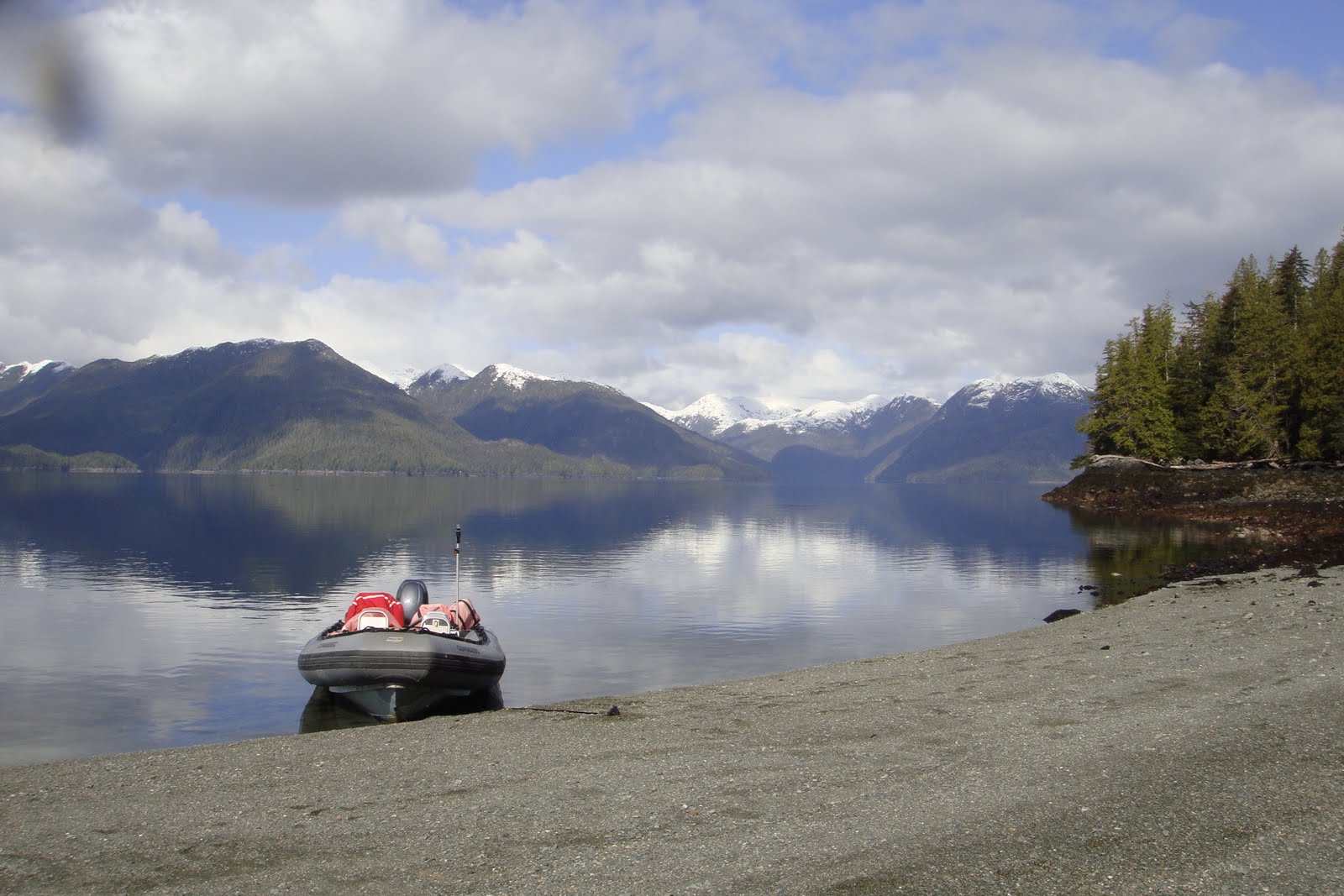
On day two, the sun was shinging and the water was calm though the air was crisp. As I sat in the zodiac as we raced over the sea, I couldn't help but feel lucky. British Columbia is beautiful. The mountains that emerge majestically from the depths of the ocean are incomparable to any other landscape I have witnessed on this earth. This is my paradise.


The first creatures we came across were some sun tanning sealions. They had their fins raised high into the air to soak up the warmth of the sun while their bodies floated in the cold salt water. We on the other hand were heading to the hot springs. We sat in the 40 degree hot spring pools under the warm spring time sun and it almost felt tropical. The sky was spattered with a few clouds, but for the most part we were able to use our lookout to eye the humpbacks in the distance and birds in the sky.


Now the absolute highlight of the trip to Gwaii Haanas - the trees! My favourite moments were being able to come face-to-face with hundred- or even thousand-year-old trees. These magnificent organisms are so unique, each one seems to have a character of its own. I learned that some trees have such large canopies that it is though they have their own miniature ecosystems thriving among their branches. The trees that we were witnessing definitely have interesting histories. The first was an alder, and it is the second largest alder recorded in the world. Next we visited some cedar trees, many of which have been culturally modified. Cultural modification implies that in the last 150 years the trees have been cut, proded or burned for a variety of reasons and you are able to see the scars of these modifications on the trees today. Last we visited the site where the battle was waged out between logging protestors and the loggers in teh 1980s. Here I got to stand at the base of a thousand-year-old sitka spruce. I hope that I have been able to capture some of its magnificence here in my photos. It makes me sad to think of these trees coming to their end, but so honoured to be in their presence while they are still alive.

Of course, no visit to Gwaii Haanas would be complete without visiting some of the Haida remains. We went to two villages to see totem poles, motuary poles and where the houses were built. Obviously, when everything is made of wood and abandoned in a forest, the environment reclaims the village at quite a rapid rate. We could still observe what the various artifacts were or represented with instruction from our guide, but I fear that these remains will soon be lost to the wilderness that surrounds them and the Haida artifacts will be best seen in museums. I am glad I got a chance to see it now!

One of the most interesting revelations that came from the trip was the fact that the Haida culture as we know it only developed after first contact when they experienced an artistic boom. The art and the totem poles are a direct result of the metal tools that were all of a sudden provided to the First Nationas group by traders that allowed the Haida more time in their day to day and the ability to create more precise forms. Also, the totem poles were a demonstration of wealth. The Haida are knows as a waring people and werew constantly trying to outmatch the other - this could be achieved by the tallest totem pole for one, or extravagant potlatches. The Haida also had slaves and were prone to fighting for territory. Not always what one thinks of the Haida. It is easy to see though how the death of close to 7,000 (from 10,000 to 3,000) Haida from smallpox in a short time can overshadow the fact that the 'conquered' group were also human.


All in all, the trip was a success. I can now leave this place feeling that I have accomplished what I set out to do on this part of my adventure - experience the awe-inspiring beauty of British Columbia.


P.S. Check out the full photo album on Facebook.

Monday, April 18, 2011

Fashion Break

For a few years now I have really enjoyed reading fashion blogs for ideas and inspiration for my own personal style - I promise that I do sometimes look stylish if you are one of the few who have yet to witness it.

Since I have now moved from the city to the country, from a behind-the-desk job to an out-in-the-field or outdoor job, my wadrobe and fashion preferences have changed. Previously, I really enjoyed delicate fabrics, nicely cut dresses and clothes primarily for their aesthetic value. Now however, clothing is valuable based on its utility. Bonnie likes to call such clothing technical clothing. So what kind of fashion options exist for this kind of lifestyle?


Some people might argue that fashion should not even be a consideration for the travelor, the outdoor enthusiast or the farmer, but I believe that fashion is valuable to any lifestyle. Fashion helps a person better define their character and mood on any given day. In my opinion, the ability to external represent yourself is what makes clothing so much fun! So here are some of the style words that immediately come to my mind for outdoor lifestyles - ski bum, gortex, hippie, tomboy, cowboy, cyclist, the North Face, retro, wool, hunter, safari, boots, hats, work gloves. As you can imagine, though it is quite easy to find a number of blogs related to urban fashion, whether it be street fashion, high fashion, business fashion or party fashion, there is little to my knowledge that is available for people that need both function and fashion together. The hunt is on.

So far I have been impressed with tomboystyle.blogspot.com though it's focus is still quite urban.

Sunday, April 17, 2011

Feral Cows and Unmanagable Deer

There are feral cows living in Naikoon Park.


Sometime in the history of the island, cows escaped from their owners and began to live in the wild. Today there are approximately 30 cows living in the park and their exisitence is one of a number of loopholes within governental regulation that evades policy or protection.


The islanders have different perspectives on the cows. Some believe that they should be hunted and shot for consumption purposes. If this were to be the fate of the cows however, this begs the question as to who will 'have' and then who will 'have not' since the number of cows to be hunted are so limited. Others want the cows to be removed because their existence as an introduced species to the island affects the local ecosystem. And of course there are those that hear about or see the wild cows and are filled with joy at the thought of their existence. (It is fascinating how unusual juxtapositions, in this case 'cows' and 'the wild', grab our fascination and affection so easily.)


If the cows are to be kept, then what kind of protections should exist? What kind of management programs should be instated? Bonnie and I went to see a presentation by a UBC student who did her term project on this issue late last week. Her project evaluated two case studies, one with bison in the US and another with horses in Canada. She basically wanted to look into what other communitities are doing to address the issue of feral animals in their environment and what precautions should be considered. Bonnie and I spotted four cows the other day - three adults and a new born. They made me smile.


There are also black tailed vermin - also read deer - that live on Haida Gwaii and need to be culled or better yet annihilated. I am now among the population of this island that is of the opinion that all the deer need to be shot, poisoned or removed by whatever means possible. To put these statements into perspective, let me explain a little about how the deer came to be here and the problems that they cause.


The deer were introduced by 'the white man' as a means to provide protein to the new residents of the island. Unfortunately, Haida Gwaii doesn't have any significant predators for the deer, and its rich forests have allowed the deer to thrive. There are now thousands of deer on the island and they can be considered nothing lest than an invasive pest. For instance, the deer are devastating the Haida Gwaii underbrush which is especially concerning because of the many native medicinal plants that once flourished as well as the potential to grow many berries or agro-products once possible. Driving to a party in Masset this weekend around dusk, we saw 50 deer along the road over a 75 km distance.


I personally dislike the deer. When I expressed this opinion with a couple of locals, I learned that a Haida Gwaii resident is allowed to shoot 30 deer a year! The problem is these deer replicate like rabbits, and what is a person supposed to do with that much meat? Throughout Canada, you are not allowed to sell hunted meat, and consequently, you or your friends and family would be responsible for eating the entire lot that you bring in. Tough situation if you ask me.

Tuesday, April 12, 2011

Farm-time Memories

This is a picture of my pet goat Princess and I when I was very young at our farm in Quebec. Princess remains one of those memories from my early childhood that I will always remember. I used to lead her around on her leash, feed her milk out of a beer bottle and teach he to jump up and give you a kiss upon command. (Kuesschen Princess Kuesschen!) Thanks Mum for sending this picture along. I love it!