I started out this morning in a fairly foul mood, not for any particular reason, other than just feeling low. Luckily the weather was nice, the air was fresh and I am one of those people that finds it difficult to be unhappy when I am outdoors. Still, my cloud of unhappiness was hanging over my head, even if a little more distantly.
We spent the morning weeding and continuing to tie tomato plants. Normally I prefer to listen to music while doing these tasks to get into a good rythm, but today I preferred to be with my thoughts. It was during this time of contemplation that I had a sort of epiphany - I am feeding people!
This may seem like an obvious thought, since I have been writing about growing food for weeks now, but for whatever reason, the idea of growing food here and actually feeding people had never really clicked in my mind. Until today, the work I have been doing on the farm has served much more selfish ends - I have learned to grow food for myself, family and friends; I have been learning how to operate a farm in order to potentially run a farm myself in the near future; I have been growing food as a 'product' to sell to 'customers' as a means of gaining an income and a living. The fact that I now realize I am responsible for feeding whole, nutritious and organic food to an inumberable amount of people, who would, in a more abstract sense, not have access to this food without me doing what I am currently doing, was quite a profound realization. I am now a part of the farming network of BC, of Canada and of the world. Without people such as myself doing what we are doing, humanity would not be able to eat!
This realization is as a result of a brief bout of Facebook jabs a friend and I have been having this week. He posted on Monday that he was glad his day was over and that it was a short week. I replied that unfortunately farmers do not get short weeks. Curious, he asked what farmers do on statutory holidays - this coming Friday is Canada Day, a national holiday for most businesses. I replied that farmers farm on statutory holidays, because the for some reason the plants never got the memo that they don't need to grow on holidays. His response was that the plants won't die in one day, and that farmers should get the memo to take a day off too.
My friends last comment made me upset. Though I understand where he is coming from, it shows a lack of understaning of the cycles of a farm and the livelihood sacrifices made by farmers to do what they do. First, just like cows get into a milking cylce, plants too get into a harvesting cycle whether it be a daily, bi-daily, or weekly cycle. For example, now that our zucchinis are producing, they need to be cultivated everyday. In fact, the growth that occurs in a 24 hr period is usually the difference between 'too small' and 'too big', so if we were to leave the zucchinis for a day, we would not only end up with a number of 'too big' zucchinis, but the plants will not have poured their energy into growing new zucchinis without the more mature ones being harvested.
Next, the farm is on a weekly cycle. If we were to take Friday, our harvest day off, then we would have to do one of two things - 1) harvest for market on Thursday, which means that our customers will have produce that isn't as fresh as they normally receive, or 2) not harvest a skip a market week. If we were to harvest on Thurdsay too, the normal work that would be done on that day would have to be omitted as well. If we were to skip a market week, we would be sitting on a lot of produce that would be bad by the subsequent week, we would not receive any income for the skipped market, we would not be able to deliver our CSAs to our buyers and overall the Klippers name would lose some of its reliability for not being present.
I really hadn't thought of all the consequences of skipping a day of work for a statutory holiday, until I mentioned this bout to my boss in the field. She said to tell my friend that we will take a day off, when he and the rest of the world start to fast because of holidays.
This comment is what made it click in my head, that I am feeding people.
Wednesday, June 29, 2011

Monday, June 27, 2011
Garlic Scape Overload
 Today we packed 10 garbage-sized bags of garlic scapes full. We still have about half the field to harvest. Luckily garlic scapes are my new favourite vegetable. Roasted garlic scapes in olive oil with some salt have become a staple in our fridge and we pretty much put the scapes into everything. Plus they freeze really well.
Sunday, June 26, 2011
Tomatoes: Part II
It has been a few weeks since we finished planting the tomatoes. The next step in growing and harvesting them successfully was to install a series of metal poles to which we will be building a support system for the tomatoes to grow up (vertically) instead of out (horizontally). Luckily, Steve took care of this quite laborious task on our behalf.

Then this past week, we went about desuckering all of the tomatoe plants - which I estimate to be about 5000. By preventing the plants from pouring its energy into growing out along the ground, we are ensuring that the plants grow upwards which will allow for an easier harvest.

To further encourage the upward growth, we have even started tying the tomato plants to provide lateral support while they grow. To do this, we use cord and run a figure eight around each of the plants. This cord is tied taught between the metal poles so that it provides ample support to the tomato plants while growing as well as when we will be harvesting the tomatoes themselves. When you return down a row, you wrap the cord around the plants in the opposite figure eight configuration so that the plants are supported from both sides. From what I can see, I understand we will be doing this again once the plants grow a little taller.
In the green house, a different system is used where we have hung cords from the ceiling and wrap the plants around these cords as they grow. The interior tomato plants have had an ample head start, and we have already started to send little orange cherry tomatoes to the market. I am eager to try one, however we still have a freezer full of tomatoes below our appartment which my roomates and I are trying to eat our way through before this years harvest ripens. Tomato soup and tomato puree have become a staple in our fridge.

Then this past week, we went about desuckering all of the tomatoe plants - which I estimate to be about 5000. By preventing the plants from pouring its energy into growing out along the ground, we are ensuring that the plants grow upwards which will allow for an easier harvest.

To further encourage the upward growth, we have even started tying the tomato plants to provide lateral support while they grow. To do this, we use cord and run a figure eight around each of the plants. This cord is tied taught between the metal poles so that it provides ample support to the tomato plants while growing as well as when we will be harvesting the tomatoes themselves. When you return down a row, you wrap the cord around the plants in the opposite figure eight configuration so that the plants are supported from both sides. From what I can see, I understand we will be doing this again once the plants grow a little taller.
In the green house, a different system is used where we have hung cords from the ceiling and wrap the plants around these cords as they grow. The interior tomato plants have had an ample head start, and we have already started to send little orange cherry tomatoes to the market. I am eager to try one, however we still have a freezer full of tomatoes below our appartment which my roomates and I are trying to eat our way through before this years harvest ripens. Tomato soup and tomato puree have become a staple in our fridge.
Saturday, June 25, 2011
Cherries, Strawberries, Peaches, Apricots and Turnip
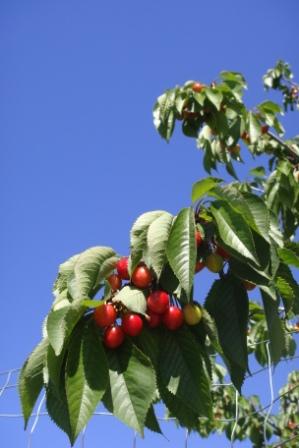 Cherries! Before living in Cawston, I would not have been able to identify what a cherry tree looked like. Though we are not officially growing cherries at Klippers this year, we do have a few cherry trees on the property which the other apprentices and I are eagerly waiting to harvest. Though we have been warned that we should be prepared to consume our cherries with added protein if you will - the reason that Klippers did not continue their cherry block lease this year is because cherries in BC are being heavily hit by a fruit fly that spreads its eggs into the fruit. The problem bad that in the industrial agricultural sector, if I understand this correctly, a new bylaw has been passed that allows farmers to spray the cherries with a protective pesticide up to 3 days prior to harvest. Previously, the spray was only allowed to be dispersed up to 7 days prior to harvest. This same bug caused cherries to go extinct in Japan.
Still knowing what I do, the cherry trees are beautiful. The red and yellow of the fruit is in beautiful contrast to our clear blue skies and the rich green leaves under which they are growing. Plus, the other apprentices and I have come up with a great solution - chocolate covered bug filled cherries. If chocolate covered cherries and chocoloate covered insects are both good, we might as well just combine them all at once!

The strawberries have also started to ripen. These little delicious burst of flavour have always been very exciting to me. Living in Vancouver, I used to do day trips to Surrey to go to the u-picks at the end of the strawberry season to take advantage of the fact that the price was $1.00/lb. I have learned I can pick a lot of strawberries. We have been happy to send strawberries to market this week and also put them in our large CSA shares.
 I am glad to report on the growth of some of our tree fruit as well. Though we are still busy thinning apples, which we will hopefully finish this week, the peaches and apricots have been left to grow under the warm sun. Above you can see the fuzzy peaches about the size of golf balls now, and below the apricots of similar size. I am unsure when both will be ready to harvest, but am definitely looking forward to it. Hopefully not too long now for the apricots.
Last, I was asked to harvest turnip this week for market. Glad to have a new vegetable to pull out of the ground, I started the endeavour of pulling these roots and getting them ready to bunch. However, much to my dismay, every turnip I pulled up had been eaten by worms! Now there is currently a discussion going on about weather the worms are wire worm or root maggot and I hope to get clarification this week. If the little pest is one of these two, he will only eat turnip, however if he is the other and we pull out all the turnip, he will migrate to carrots or beets which we obviously want to avoid.

Regardless, as you can see the turnip we have pulled are being consumed and the tiny worms just cut out. When I was assigned the task of cultivating the turnip, I honestly had to stop and ask if we really couldn't sell any of them - I figured that people have to realize that organic means that there are pests, so maybe consumers ok if there is only one worm? At the Penticton farmers' market this weekend, other farmers had gone about cutting out the worms and bagging the turnips together to sell. It seems turnip is just not meant to be grown in Cawston (sorry Mum).
Wednesday, June 22, 2011
Apple Thinning and The Deal with Ants

Goodness we have been busy. Here is a quick update.
We have started apple thinning. We are thinning a number of different varieties of apples, which if I am correct include, gala, fuji, red delicious, winter banana, macs, spartans, garlic, golden delicious, musu, honeycrips, pink lady, discovery, cox pipen, and ambrosia apples.
We have started apple thinning. We are thinning a number of different varieties of apples, which if I am correct include, gala, fuji, red delicious, winter banana, macs, spartans, garlic, golden delicious, musu, honeycrips, pink lady, discovery, cox pipen, and ambrosia apples.
To thin apples, you generally want the apples to be 6 - 8 inches apart dependent on the variety. Also, if a tree is very loaded with apples, it is better to thin it a little more so that the fruit grow to a reasonable size. When thinning, you can see apples that already have a yellow stem are being thinned naturally and will fall off at a simple touch. The other need to be picked off without removing the stem from the tree if the apple is in a bunch - you do this to prevent the stem from the apple you want to keep drying out and falling off as well.
While thinning, we discovered that there are a lot of ants that live in the trees. It turns out that the ants are there to eat aphids on the leaves. However, not only do the ants eat the aphids, they also farm the aphids! This means that the ants carry the little insects up to the fruit of a tree so that they can get juicy and fat, and then they come and get them once they are tasty and delicious to feed to the colony at the base of a tree.

One of the workers said that they would like to be an aphid if they were to come back as another creature - born, carried to the feast of your life, eat until you are essentially silly with a food coman, then carried to your death. Not for me.
On the farm there are also a few unusual experiences that have been had recently. First, I was mowing one of our fields that is on rotation this year - it is only covered in a cover crop for the season and we want to prevent the crop from going to seed and spreading to the other fields - and I somehow got metal fencing and chicken wire wrapped all around the mower. Unable to mow with such a tangled mess, I had to get some wire clippers, get myself under the mower and cut out the tightly wound fencing. Not a bad job, but while I was under there, I got a bit anal about cleaning the mower. There was a ton of mud and dirt caked on, so after I finished with the wire cutters, I got a hammer and chisel and started knocking away all the crud that had been stuck there. Very satisfying.

There also seems to be a problem of disturbing dolls and doll parts being found about the property - the Klippenstein's have two young girls and I think some of their toys have been left behind and taken by the elements. Well, someone thought it would be hilarious to cover the stick shift of our on farm vehicle with a doll head. Please witness.

Annamarie finally got creeped out enough that she through it out. I must admit I do miss the creepy doll head a bit, it brought a unique character to the farm. :)
Tuesday, June 14, 2011
Community Supported Agriculture (CSA)

Farming is arguably one of the most seasonal industries in existence - the success of a farmer is completely dependent on the weather conditions, length of the growing season and occurence of any storms. Therefore, a farmer must make the bulk of their annual income in a few short months, the summer months. This can understandibly put considerable strain on farmers to have sufficient cash flow to allow them to conduct their business throughout the year. Think for instance of how much money must go out in the spring for seed, for seeding trays, irrigation pipes and so forth to set up the fields for the season with very little coming in.
To curb this cash flow dilemma, Community Supported Agriculure, also known as CSA, was brough to life. CSA is a means of giving farmers money in advance of the growing season by purchasing 'shares' of the crops that will be sold at market each week. Essentially, a customer signs up for a CSA, at Klippers either a large ($40.00) or small ($25.00) share for 20 weeks, and pays the farmer in full for their share prior to the commencement of the season. In doing so, the CSA customer is guaranteed to receive produce everyweek for 20 weeks, but also takes on some of the crop-failure risk with the farmer.
Benefits to the consumer are that they get priority on the variety of products harvested each week and they also are guaranteed their food no matter when they show up at market to pick up their box. (Klippers delivers their CSAs to any of their four markets.) This means, customers don't need to rush to the market at 9.00 am to make sure they are getting their zucchinis right now.
Downfalls for the consumer are that they don't get to decide what produce they receive weekly, and they are taking on risk with the farmer if there is a crop failure, they don't get their money back.
Benefits for the farmer is that they are receiving much needed cash in a slow time and are also not taking on all the risk each season for their success, so they can hopefully continue to farm in the future even if they were to experience a crop failure.
Downfalls for the farmer are that the CSA organization is labour intensive to put together the boxes and bags, and often times CSA customers are not fully aware of the details of a CSA (esp. regarding the risk and lack of choice.)
This year, to curb the labour issue for one, Klippers Organics have sold CSA gift certificates to consumers in place of shares. How this works, is that individuals can buy their gift certificates in advance and receive an extra 10% (ie buy $500 and receive $550 of gift certificates) for their commitment. As a bonus, the gift certificates can be used to buy products from Klippers at the winter markets or into the subsequent season should the consumer not be able to use them by the end of the 2011 season.
Also, hopefully the gift certificates will allow consumers the flexibility to buy exactly what they want for their share, however they now too are subject to getting to the market early to get the selection of products available.
I am in charge of organizing the CSAs at the farm. This means that I will email the customers an outline of the products they get each week accompanied by some recipes for less common foods as well as answer any queries. I also organize the boxes and bags at the farm when we are packing for market.
So far so good!
June 8 - 15, 2011: Weeding and Planting
 This past week was filled with emergency weeding sessions and lots of planting. We started the week weeding the carrots and beets that we did not finish at the end of the previous week. Over the weekend when I was in Vancouver for the markets, there was a hot spell here in Cawston, so the weeds shot up very quickly in our absence!
I have learned that one of the good sides of weeding and thinning, is that most of what we weed and thin is edible. In fact, sometimes we bring lamb's quarters to market, which is a eaten most often as a salad green, but on the farm it is primarily a weed between our crops. Similarly, in order to grow full beets, the plants must be thinned when they are young. The baby beets are also edible as greens, so after one morning of thinning I came home at lunch time with a stuffed bag and armful stuffed with baby beet greens. Our fridge was very full for a good many days until I pureed the greens to make a delicious coconut curry beet green soup!

We also started last week planting squash. It was the first time I have planted something directly from seed. I learned that you generally want to plant the seed at a depth of three times the seed size. It doesn't matter what direction the seed is facing, but it was important to give it ample space within the mulch so that the seeds germinate and grow. I was fascinated that I didn't know a good number of the varieties of squash we planted and look forward to learning more about them when they grow.
In order to seed one of our fields that is pestered with bindweed, a weed that would tangle itself around our plants, we had to lay out huge rolls of black nylon sheets to mitigate the weed growth. Also, the reason that it has been so important to get the squash seeds into the ground is because we must make sure that the squash can reach their maturity before the first frost. At this point, we are supposedly close to that deadline based on the weather patterns from previous years.
On Wednesday we harvested for the market at Main Street in Vancouver. We had red and gold beets, green onions, kale, salad mix and eggs available for sale. We also harvested collards, which I didn't realize were the leaves of any plant from the collard family - collard is short for colewart which means 'cabbage plant'. The collard family includes broccoli, cauliflower, kohlrabi, cabbage, kale and brussel sprouts. This is just proof again that one can use everything a plant has to offer in some way.
Planting continued throughout the week. We have planted eggplants, melons, zucchini, lettuce, celery, celeriac, fennel, tomatoes, basil, parsley, tomatillos and peppers. Obviously, or maybe not so obviously, we have planted a plethora of varieties of each of these food types. The reason I say maybe not so obviously, is because though I again consider myself a foodie, I have been completely ignorant of so many of the cultivars of these plants, and I can see how this fact might be overlooked by readers.
We finally returned to the wind-swept tomato field to mitigate the damage done by the heavy windstorm in early May. Though the surviving plants are thriving, I would say that farmer Annamarie's 50% loss estimate was fairly accurate. Some rows were more than 50% lost while others maybe only 10% loss. Hopefully our later transplants are able to catch up and start producing.
The weeds also shot up in the chicken fields, so we got in there to mow down the brush to keep it under control. One of the added benefits is that you can also find hidden nests then too! Here you can see that a few chickens found a deep patch of grass to make their nest, but it was only revealed after the weeds were mowed.

The last bit of exciting news is that the field of garlic at the front of the house has just started to scape. This means we will have garlic scapes at the market soon!

Subscribe to:
Posts (Atom)